The Old School Dungeon – Preparation for Leading a Game
Soup-to-nuts
I have been very busy, engaged in other matters, and like Gandalf I have arrived late. I do hope you will forgive me. Like redoubtable Hobbits I am sure though that you have found your way through the wild. Let us continue our exposition.
My intent is to provide the reader with such insights as I can provide from my own experiences playing and leading our game. What follows is my own interpretation of how to play as drawn from the rules, with deviations, and of course you are free to draw your own conclusions about the rules and from practical experience and play as you like. There is no particular recipe for an enjoyable social gathering, snacks and beverages, but we’ll set out on our journey much like Bilbo Baggins, rushed out the door of Bag End and not knowing quite what to expect!
I should mention that in the previous article I listed some references to texts which span from the origins of the game through BECMI. They are well worth reading but I will not however abandon you at this doorstep:
- D&D Volume III of Gygax and Arneson’s The Underworld & Wilderness Adventures, Example Of The Referee Moderating A Dungeon Expedition beginning on page 12
- Example of play in Holmes on page 39
- Sample Dungeon Expedition in Moldvay on page B59
- The Solo Adventure in Mentzer’s Players Handbook on page 13, as well as,
- Your First Game beginning on page 4 of Mentzer’s Dungeon Master’s Rulebook, (BECMI)
This of course is jumping ahead a little as there are other things to consider.
A Social Gathering – In Person
It’s helpful if one can find people with similar interests. A gathering of players is a matter of culture but I will emphasize this, our game is meant to be played in person; it is therefore at its best a social gathering. People must therefore have the opportunity to come together, and when they do this is therefore a choice, an important one, that deserves respect.
Nowadays there are many more activities, and obligations, which compete for our attention. Many modern entertainments simply did not exist when our game first came into being; which then made our imaginary adventures much more exciting. There was nothing else quite like it. Moreover, we are subject to many pressures not the least of which are our own obligations. The world around us draws close. The best games are immersive, in the sense we temporarily suspend all thought of our cares and woes as we take part in the shared adventure and are left not only with a sense of fulfillment but a longing to continue. Our game is an escape.
Location
When I was first introduced to the game we played in a teenage friend’s basement, sitting on old furniture, around a makeshift table of plywood to roll dice on. In the 1980s we played in the kitchen, and later in the basement. Then my table was an old door I put legs on. A living room coffee table can work as well. The main consideration is seating for everyone and comfort. If you are using theatre-of-the-mind you will not need as much space. However, a surface is needed for battle maps and miniatures if you use them.
As the leader of the game you will want to conceal your full maps, the secret texts of your underworld and wilderness, and you will need a place to make some secret dice rolls where the player’s cannot see the result. We’ll discuss what rolls should be secret and which public later on.
The original game only had three little books, and if you have printed copy you will want the book you use handy. Be wary of loading yourself down with more than you really need. The last thing you want is to spend your time flipping through the rules looking for something. Sticky tabs are a great way of marking important pages. As you will soon discover with character creation the rulebook will soon have you flipping back and forth.
Stuff
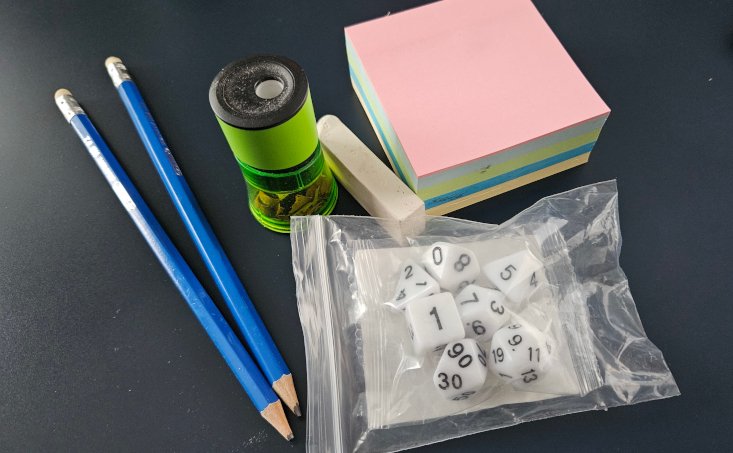
Everyone is going to need a pencil. You’ll need a really good eraser because the one’s on the end of the pencil will soon rub through the paper, a pencil sharpener, a pad of paper, and dice. Soon everyone will want their own but you only need one set to start with, and maybe a spare for when the cat bats a dice under the sofa and it now belongs to them. I’ve seen some fancy dice but what you need are plain ones with good contrast that are easy to read from a distance.
Overarching Story
I have mentioned, albeit briefly, that character advancement in the game requires players defeat monsters and gather treasure in order to collect the necessary points to rise in capability. What players remember is not this but the shared adventure, risks, gaffes, failed and successful dice rolls, and good humour shared around the game space. The shared underworld adventure is fundamental to that social experience. The overarching story begins with journeys to and from the underworld, the adventures therein, and thus sequential events build from session to session over weeks and months. The idea of the progress of time, in effect story by default, is built into the game. Now this is not quite a “story with value” as you might find in a great novel but the aggregated adventures begin to share something of its qualities; early on “plot” over top of the foundational elements of the game will not be very necessary.
Initially, the “adventure as sequential story” need be nothing more than:
- Beginning at the underworld entrance, enter the underworld.
- Exploring the underworld.
- Exit the underworld, collect experience points, restore lost hit points.
Or:
- A short journey to the underworld from the Coldford Inn.
- Exploring the underworld.
- A short return wilderness journey to Coldford Inn, collect experience points, restore lost hit points.
Beyond the wilderness to underworld journey the player characters will eventually be looking for some new underworld to explore if you have not broadened the underworld map, refreshed it, and deepened it beyond three levels. Part of that experience for you and and the players is driven by the need for new challenges as the characters rise in level.
The wilderness is and should be largely unknown, and the simple necessity of mapping the wilderness, as the players do with the underworld, is a source of untold adventure. Wilderness therefore provides scope for new adventures well beyond our introductory underworld.
Overarching story can be created from the guidance provided in the rules. I’ll cherry pick a few examples of “scenarios” as Moldvay describes them from page B51 which have the potential to fit well within our wilderness and creatively link them. These aren’t grand stories but short adventures which, with a little imagination, have the potential to sequentially connect with each other and create a narrative in time:
- Exploring the Unknown: The party is hired, perhaps by merchants, or officials, to map a specific region of unknown territory near the Bordermen’s Road. The number of hexes to be explored is defined. Map exploration, a hex-crawl, is required. The party will be expected to deliver an accurate map. If they get lost this of course ruins their map and they must sort it out. In the process of their hex-crawl they discover that the minions of evil, who could be bandits, monsters, an evil magic-user, or an evil cleric, are in the process of building a fortified camp in one of the hexes. The outpost of chaos is a “camp” but could also be an old ruin, an abandoned village, caves, etc.
- Investigating the Chaotic Outpost: This scenario has to do with a Chaotic invasion (either in progress or about to begin). The minions of chaos have now fortified their camp in one of the hexes the characters have been previously hired to map. The characters are now hired to spy on and enter this enemy outpost to find out the strength and plans of the invaders. Perhaps they recover a scroll, a letter and map describing the intentions of the minions of chaos. Perhaps they must capture and return with a prisoner to gain the information.
- Rescuing Prisoners from Chaos: The party must rescue important prisoners who are being held captive by the minions of chaos in their fortified camp. This could be an Official of the Realm or some other important personage like a Rich Merchant or a noble person betrothed to someone in The Realm.
- A Lost Shrine: The party must travel to a hidden shrine which has been lost for ages and consult its Oracle. The player characters usually have only a rough idea of its location so map exploration is required. At the shrine the information the party learn as a result will aid them in the dark times to come as they must soon confront the minions of chaos.
- Assaulting the Chaotic Outpost: The party must now enter the fortified enemy camp, drive out the minions of evil, and destroy the camp.
Your players will either eat this sort of thing up or go off on their own tangent. Don’t be disappointed if they ignore such carefully laid plans. If you have a calendar events these scenarios can proceed independently of the player characters. The players can easily ignore some part of the overarching story sequence and join in at a later step. Or, they may have to face the minions of chaos when they are much stronger…
This is where alignment test consequences of player action/inaction come in; what if the minions of evil are undisturbed and succeed in building their fortified camp? What they do next may well eventually conflict with the plans of the player characters:
- The site of the fortified camp, possibly beside the Bordermen’s Road, will allow chaos to interfere with trade, and
- The minions of chaos will tax and rob the merchant caravans, slaying all who oppose them, and
- Chaos will only grow bolder and stronger. Drawn by the prospect of plunder the numbers and strength of monsters will increase, and
- The minions of chaos will build a stronger fortification.
Character Preparation
We have our underworld, three levels, and wilderness. All we need are characters for the players to role-play. A good chunk of the time you have to play can initially be spent on character creation. If your group is sympathetic, and interested, and you have the time, you can guide them through the process of character creation and the effort will be very well spent as they will invest in their characters. If you yourself are unfamiliar with the process then you absolutely must create characters and equip them yourself before the game so you understand exactly how it is done. Make at least one character of every type. You can allow the players to choose from these if you wish and it will save you preparation time you can then spend playing. However, players will not then understand how they are made and may be less likely to value and personally identify with them. Some players make the leap of imagination and some do not.
- For my Gloomland adventure I created several ready-to-play third level characters which you are welcome to make use of. These were prepared specifically for Labyrinth Lord but are generally applicable to most B/X games; Burly Barleycorn, Gruff Stonebeard, Hamfist Strongthorn, Heyou Halt, Magus Astra, Rowan Treefriend, and Tertius Lumina.
The Character Sheet as a Form
I prepared a character sheet for my Travel Stone adventures which you may use to create your own characters.

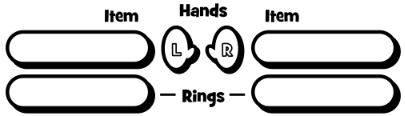
These things always look terribly complicated at first but they aren’t hard to use. We just used to use any paper we could find per the example in Moldvay on page B5 but the form makes it easy and ensures you won’t miss anything. I emphasize function over aesthetic appeal. The form is intentionally basic and uncluttered. Most such sheets do not include what the characters are holding in their hands but I think this is really important as the characters aren’t meant to hold a sword, shield, a torch and a lantern at the same time and they are only meant to wear one magic ring per hand.
Deviating from the Canon of Character Creation – Pick a Class
You are certainly welcome to create your Characters following the method outlined in Moldvay or Mentzer do; I refer you to:
- page B5 of Moldvay,
- page 48 of Mentzer,
- OSE’s Classic Rules Tome page 14, and
- Labyrinth Lord page 6.
I don’t quite follow the typical sequence. Although it may seem strange to begin defining a character in the following manner the idea is to provide a compelling foundation before proceeding further. Let’s begin with something oddball, choose a Class first. If there is any confusion you can read the descriptions in the rules about the classes to the players so they understand them.
Most players may have some idea what sort of character they’d like to play and the options are: Human – Fighter, Cleric, Magic-User, or Thief; then Dwarf, Elf, and Halfling. In most cases you’d want the party of players to be composed of at least one each of the first four. That means at least four players! The “Fighter” can be substituted with a Dwarf, the Magic-User with an Elf, and the Thief with a Halfling. These aren’t quite the same characters with the same abilities but a perusal of the rules will reveal why this substitution makes some sense. There is no substitution however for a Cleric and the party really cannot do without at least one such character.
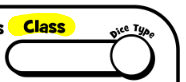
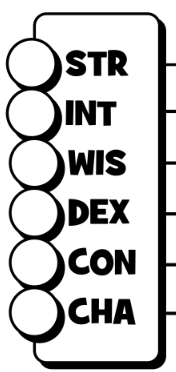
House Ruling. After picking a class, let’s say we choose the Class of Fighter, we write what it is in the place at the top right of the form and then roll four six sided dice for each of the six Abilities: Strength, Intelligence, Wisdom, Dexterity, Constitution, and Charisma. We are meant to roll three six sided dice in order, but we deviate from this; out of four dice pick the best three, sum them, and then from the pool of six sums plug the numbers into what slots we understand are most appropriate to the class we have chosen; our pool: 15, 13, 14, 16, 7, 11.
Prime Requisite
Each Class has a different Prime Requisite. STR is the Prime Requisite Ability for a Fighter. We cannot have a number of less than 13 in a Prime Requisite. Additionally certain Class have other Ability requirements, for example a Dwarf must also have a CON of at least 9.
The Prime Requisite Experience Point Bonus
If our Fighter’s STR is 15, their Prime Requisite, they gain + 5% to earned experience points. We put +5% in the XP Bonus spot at the top right of the form. This bonus greatly affects the character’s progress through the levels. Do not underestimate its benefit over time.
Assigning the Remaining Numbers to Abilities
After the Fighter’s Class Prime Requisite is satisfied we then assign numbers to DEX, WIS and CON. Dexterity affects combat, Wisdom saving throws, and CON hit points. DEX, WIS, and CON affect the play of the game which is why I prioritize them after the Class Prime Requisite and other requirements are satisfied.
Now regarding this placement of numbers from the pool we are not following the strict canon of the rules but I feel the game is challenging enough so we may as well set out putting the best foot forward. We use our judgment allocating numbers from the pool of sums to Abilities where we felt they are most appropriate.
STR
Bonuses and Penalties are derived from the numbers assigned to the Abilities. Consulting page B7 of Moldvay we can then plug these into the spots for them on the character sheet. STR grants three potential Bonus or Penalties, To Hit, Damage, and Force Doors. To the right of our Ability we write the values derived from a score of 15 from the Strength table on page B7, +1 to Hit, +1 to Damage, and +1 to Force Doors.

This process is similarly repeated for each Ability.
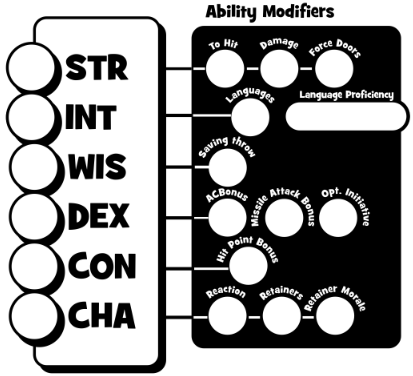
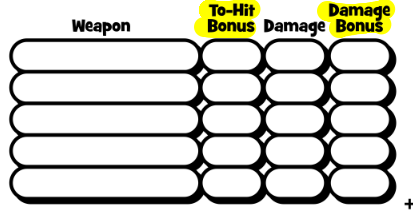
In the category for Weapons toward the bottom of the form in each row we enter +1 in the places for the To-Hit Bonus and the Damage Bonus.
At the middle right of the form we would normally enter 2-in-6 in the place provided under Force Doors. This means the character, in fact all characters, can force an unlocked stuck door open by rolling a 1 or 2 on a six sided die; refer to the topic Doors on page B21 of Moldvay. However, our Fighter gets a +1 bonus which means that instead we enter 3-in-6 in the place provided in the form; a roll of 1, 2, or 3 on a six sided die means an unlocked stuck door is forced open.

WIS
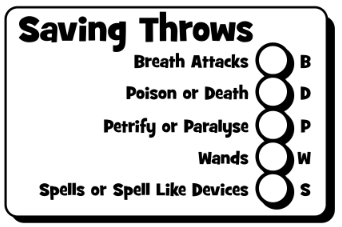
Each Class has its own Saving Throws and let us propose that an Ability of 13 grants our Fighter a +1 Bonus to Saving Throws. The saving throws are listed in the middle of the form and if we consult page B26 of Moldvay we see that the saving throw for a 1st to 3rd level Fighter vs. Dragon Breath “a Breath Attack” is 15. We invert the ability saving throw bonus and deduct it, 15 – (1) = 14 and write 14 in the space provided. Following the same method we then fill in the rest of the numbers in our form as found in the table. This saves looking them up each time they are needed and applying the modifier to the dice roll.

DEX vs. CON
This may not seem important at first but is it better to have a higher DEX or CON? Which is the most important and useful? Is it better not to get hit in the first place or to have more hit points? Are ranged attacks a priority for the character? Each person is allowed to decide for themselves.
DEX
The DEX ability grants us several useful bonus so it is well worth paying attention to, an Armor Class (AC) Bonus, Missile Attack Bonus, and an optional Initiative Bonus. Let us propose we allocate a Dexterity of 14, this grants us a -1 AC Bonus (that’s a good thing!), a +1 Missile Attack Bonus, and a +1 Optional Initiative Bonus.

In the AC section at the top right of the form enter the -1 in the two places under the Dex Bonus. The first row in the form is for calculating a Character’s Armor Class with a shield and the row below calculates AC without a shield; that is why we enter it twice.
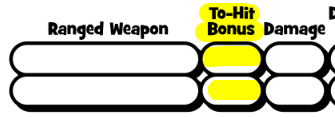
In the Ranged Weapon category at the bottom of the form we enter +1 in the places for the To-Hit Bonus.
CON
Let us propose we allocate our Fighter a CON of 16 and, consulting page B7 of Moldvay, we learn that this grants us a Hit Point Bonus of + 2 points per hit die. This is a long term benefit.
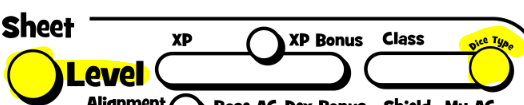
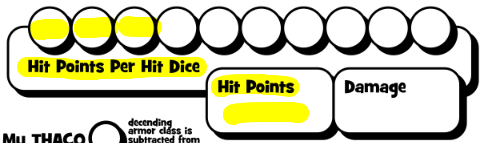
As we are to begin our character at Level 3, we write a “3” in the place provided at the top of the form to the left of the word Level and the character class Hit Die Type at the top right of the form in the place provided beside Class; for a Fighter this is an eight sided die, “d8”. That means we add +2 to the points for every level. We are meant to roll the dice at each level but I would grant a full 8 points for the first level, and add +2, for a total of 10 points. We mark this down in the place provided on the form beginning at the left of Hit Points per Hit Dice. We then roll d8 for the following two levels and add +2 each time, 6 + 2 = 8, 4 + 2 = 6. We record these in the next two places in the form. We then sum the numbers 10 + 8 + 6 = 24 Hit Points and mark it in the place provided in the form under Hit Points.
Note: I do not use d4 for class dice type. I feel it is too low. So for any class which uses d4 I would bump it up to d6. The original game did not use variable dice for hit points; all class used d6.
INT and CHA
Intelligence and Charisma play their part for the Class of Fighter but I do not prioritize them. The reader may feel differently. These are just my impressions and decisions. Again, for a different Class, such as a Magic-User, INT is the Prime Requisite and STR perhaps a secondary or a tertiary consideration. You will need to consider the needs of each Class separately.
Ability Score Adjustments
Note that in allowing the players to assign the character’s Ability scores from the pool of numbers I would not then permit Ability Score Adjustments per the rules on page B6 of Moldvay unless the character cannot meet the minimum score of 13 for a Prime Requisite from the numbers available in the pool. Some may find my adjudications objectionable and if so then by all means follow the canon of the rules as you understand them per pages B5 and B6 of Moldvay or per rules you are using.
Finding and Hearing
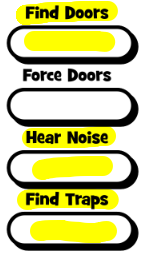
At the middle right of our form we see places for Find (Secret) Doors, Find Traps, and Hear Noise. Write 1-in-6 in each place if the Class is Fighter, Cleric, or Magic-User. Thieves have a 1-in-6 chance of finding secret doors, read further below for my comments regarding the Thief’s Class ability of Finding Traps, and a 3-in-6 chance of hearing noise. The Class of Elf has a 2-in-6 chance of Finding (Secret) Doors. The Classes of Dwarf, Elf, and Halfling have a 2-in-6 chance of Hearing Noise. Record the values appropriately in the provided places.
To Hit?
In the form we need to enter the My To Hit values; for reference I have included both Descending Armor Class (as used in Moldvay and Mentzer) as well as Ascending Armor Class, and THAC0 as used in other systems. I like my Armor Class Descending, naturally. Consult the Character Attacks Table in Moldvay on page B27. In the row 1st to 3rd, we see that under Armor Class 9, the number 10 appears. On our form we invert and deduct our STR attack bonus 10 – (1) = 9 to enter 9 under the DAC row column 9. We can then fill out the remainder of the row increasing by 1 in every place as we move from left to right, 10, 11, 12, 13, 14, 15, 16, 17, 18, and 19.

A row for My Ranged To Hit is included because the character may or may not have a DEX To-Hit bonus. As our proposed Fighter has such a bonus we invert and deduct it from the base value 10 – (1) = 9 to enter 9 under the DAC row column 9. We can then fill out the remainder of the row increasing by 1 in every place as we move from left to right, 10, 11, 12, 13, 14, 15, 16, 17, 18, and 19.
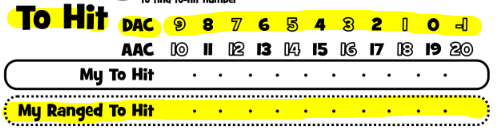
The value of recording the above is that the player knows exactly what they need to roll using d20 to achieve a successful attack. The range adjustment for distance is then the only modifier applied to the dice roll.
Note: You do not have to do it in this way, you can simply enter the values from the table on page B29 in the first row as they are beginning with 10 under AC 9 and apply any Ability bonus to the player’s d20 dice rolls like we did in the ol’ days.
THAC0
THAC0 is the value under AC 0, which for a 3rd Level Character is “19”, and the STR or DEX attack bonus is applied to the player’s dice roll. THAC0 isn’t hard to use, you simply deduct the defender’s descending AC from 19 to get the number you need to hit, 19 – AC 7 = 12, and then apply your modifiers to the d20 dice roll. A d20 melee attack roll of 11 +1 =12, a successful attack!

You can also invert the bonus and deduct it from the THAC0, 19 – (1) = 18, and record that instead in the place in the form. You do not then need to add the modifier to the dice roll, 18 – AC 7 = 12. A melee attack roll of 12 or better indicates a successful attack!
AAC
I never use AAC but some do which is why I include it and I won’t attempt to discuss its use here.
Rounding Out the Character
Now you may feel that I have coddled the player and gamed the system somewhat up to this point. My intention is, due to my understanding of the effect of the six base Abilities and the bonus or penalties derived from them, not to create a super character, but one that at least moderately enjoys the favour of chance within the scope of the rules. The player could still quite easily have a pool of Ability numbers that are not grossly over the top with some low rolls thrown. Moreover, you could still decide to follow the extant rules and use only three dice to create the pool of numbers. This is your game.
At this point we should roll for the character’s starting funds, the sum of 3d6 x 10 = the number of gold coins the player has to equip their character. Most of the remaining part of the form is devoted to armor, weapons, equipment, and an area for notes about Class abilities. Unless they are very lucky, or are able to plead with the other players for a loan or gift, chances are our Fighter will have some difficult choices to make starting out. They must decide what sort of weapons, armor, and equipment they want, and that usually means compromising. The player cannot treat their character as something to hang equipment on, particularly if you are enforcing the encumbrance rules, and I cannot emphasize this enough how much I recommend this as it has a profound impact on the entire game.
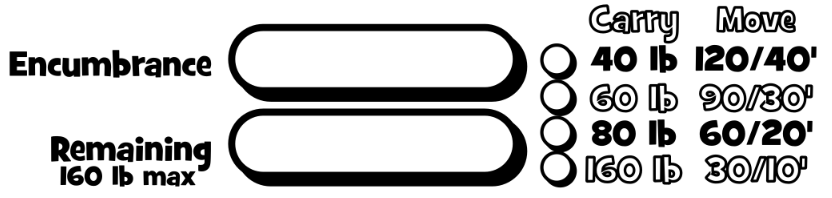
As equipment is added be sure to total its encumbrance in order to determine how much the character can carry and how quickly they move. Refer to the encumbrance table on page B20 of Moldvay for a list of what the encumbrance of an item is. 10 coins (regardless of their type) “weigh 10 lb”, and a character can carry 160 lb or 1600 coins. This use of the term “weight” now creates a very misleading impression as encumbrance is really meant to represent both weight and bulk. Moldvay lumps all miscellaneous equipment, ropes, spikes etc., into one 80 coin category which is terribly convenient. However, in the Mentzer Expert Rules on page 19 each item’s encumbrance is defined and in my opinion this sort of rule will spawn endless bean counting, which is why everyone then wants to ignore any attempt at a detailed encumbrance. My advice – keep it simple in order to reap the benefit. You may enjoy the article Encumbrance – But what has it got in its pocketses, eh?
Let’s roll some dice and purchase some armor for our Fighter. We roll 3d6, (4 + 5 +4) x 10 = 130 coins. The cost of weapons and equipment is on page B12 of Moldvay. From this page we’ll pick some armor and other things. The problem is how to strike a balance between adequate protection , weapons, and the equipment needed for exploration in the underworld. The Party as a group can share out some of the costs.
The better the armor the less likely will be the chance of a successful hit by a foe. Each type of armor has an Armor Class which we will record on our form as this information is used a lot.
Let’s pay 60 gold, nearly half of our funds, for Plate Armor, AC 3. This is the best armor the player’s character can get short of magic armor. We record this information in the form as the Base AC:
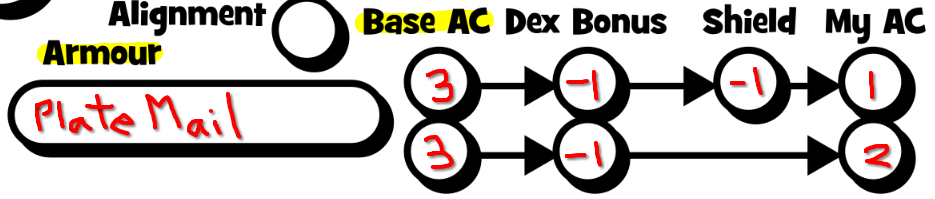
You may recall that previously we recorded the DEX Bonus. We deduct this from the Base AC, which gives us My AC of 2, when the character uses a shield we deduct another -1 which then makes My AC (in that context) 1. A player cannot carry a torch and use a shield at the same time.
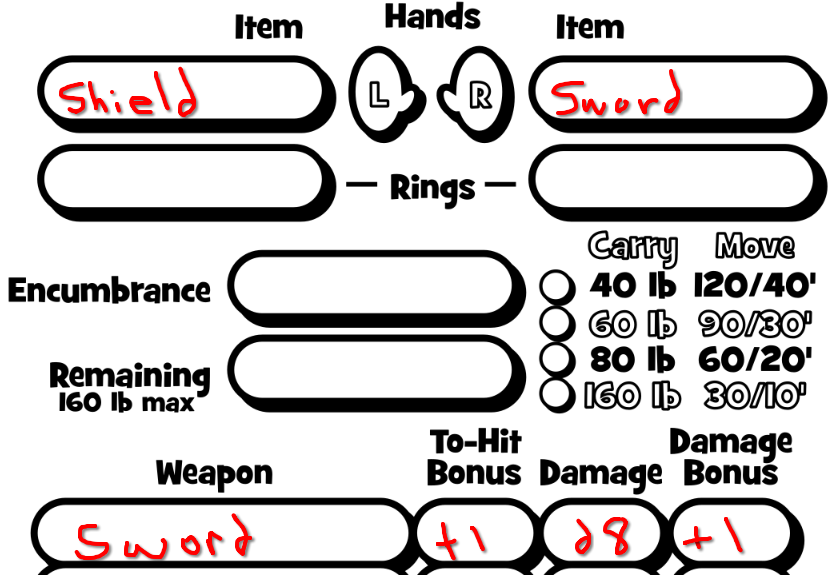
We’ll buy a Shield and a “Normal Sword” for another 20 coins, 130 – 6 – 10 – 10 = 50 coins left. We’ll record in which hands those items are and write down the weapon, bonus that apply, and damage die in the form. In our game all weapons cause d6 damage unless the optional variable damage rules are used, per page B27. There are some losers in variable damage notably the dagger which makes playing a Magic-User much less fun. Monsters all use variable dice.
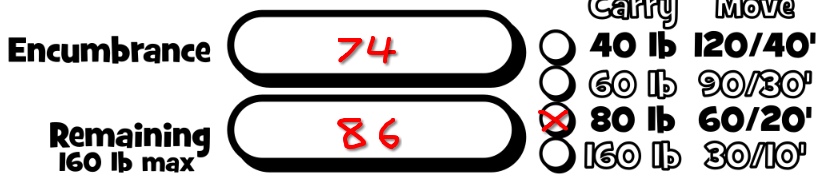
So far, referring to Moldvay, our encumbrance is 500 (armor) + 100 (shield) + 60 (sword) = 660 coins, or 66 lb, which means the character is over 60 and under 80 and so currently would move 60’/20’. However, we still haven’t got any food, rope, or other goodies, and we will likely want a few coins remaining to spend at the Coldford Inn for lodging etc. The ephemera of equipment, assuming we do not purchase any more weapons, will add at least another 8 points to encumbrance which then brings the character to 66 + 8 = 74 lb but still below 80 lb meaning movement will be 60’/20’ as long as we do not go over 80 lb. The character can carry 160 – 74 = 86 lb, or 860 coins; we write Encumbrance 74, the Remaining 86, and mark beside 80 lb for easy reference. When the character carries more than 80 lb, we’ll assume treasure, their movement will decrease to 30’/10’.
I won’t burden you with the particulars of the contents of the player’s back pack other than to suggest at a minimum food, torches, a tinderbox, and rope. Oh, and one other thing, if a character purchases a 10’ pole remind them they must assign it to a hand.
The character does not have a missile weapon, and I recommend a Sling with 30 Stones as this has a cost of 2 coins and an encumbrance of 0 as it is not listed on page B20. We can assume that they are included within the general equipment. Stones will not cost the player anything further to replenish when they can freely gather them. Note however that Mentzer, in the expert rules on page 19, gives the sling and stones an encumbrance of 10 and his Expert Rules have a detailed and somewhat different accounting of encumbrance. Do not mix the two encumbrance systems, use one or the other. I’d stick with Moldvay’s reckoning of encumbrance.
On page B27 we can find the statistical information for a Sling’s damage and range adjustments. You may recall that previously we recorded the DEX Bonus. DEX gives us a +1 To-Hit Bonus but do not include any Damage Bonus for STR as it does not apply. Again, when variable damage is used the sling is less effective.
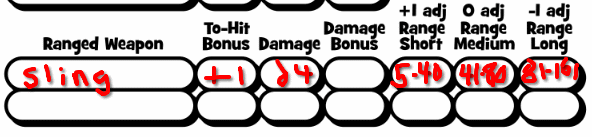
Our character now needs a name and an alignment. The player has to take a leap of imagination, perhaps with a little humour, and give their intended role an aspirational name. It’s sometimes handy to write the player’s name on the sheet as well just for identification, but this isn’t them!

A character’s alignment can be Law, Neutral, or Chaos. In theory it is actually supposed to be a secret but you can mark it down if you wish. As the Ref, you will want to keep track of the player character alignments if they are secret.

A character has to pick their languages and these are derived from INT, lets say we have assigned a 7 from the pool of Ability numbers, refer to page B7 and we learn the character can write simple common words. Every character knows two languages, Common and their Alignment Language which includes hand signals, etc. A 7 does not grant any further language bonus.

We can write Common – simple words, and the alignment language under the area at the bottom of the character sheet. This area is for Class specific Abilities etc.

Spells
As we are starting our characters out at Level 3, Elves and Magic-Users are granted spells: two first level and one second level. Refer to page B8. This relieves some pressure and one of those two first level spells should really be Read Magic or all magic scrolls are impermeable. I refer you to the following article in which I discuss the value of Read Magic. A Magic-users First Spell Should Be Read Magic.
Note: I never really understood why the ability to read the secret class magical language the scrolls are written in wasn’t an inherent special class ability for Magic-users and Elves. Per page B49 of Moldvay, any character can potentially read a Clerical scroll because they are in written in the “Common tongue” but they can’t execute the spell on the scroll because their class lacks divine power. Without Read Magic however the Magic-User or Elf is forever in the dark with regard to the magic scrolls for their class, and that is 75% of all scrolls. Did the designers of the game hate magic? Beginning a character at 3rd Level removes some of the “one spell” initial pressure encountered by the Magic-User or Elf at first level.
Clerics are granted two first level spells and the ability to turn Undead which is why the Party simply cannot do without a Cleric.
Thieves Class Abilities
In an odd deviation the designers decided not only on overlap, I am referring here to the x-in-6 chance of finding traps, but then enshrined other Thieves Class Abilities in d100 percentage rolls graduated by level. The problem in the design is that any other character class has a 1-in-6 chance of finding a trap, which is actually 16%, and the Thief, who should be the expert, at first level has a 10% chance, less! I would house rule that the Thief Level 1 class ability Find and Remove Traps should start at 20% and progress at 5% increments per level until Level 10, thereafter increasing by 1 point per level until a maximum of 99 is reached. The class ability includes removing the trap which no other class can do.
In the Following Articles
In the next article we’ll continue our preparation for the game. Until then!


