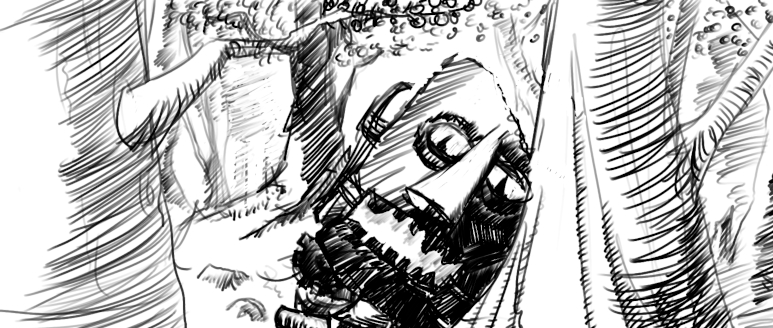
The Old School Dungeon – Level 3, Automatons
G. Bruce MacKenzie
Level 3
Inspiration has struck! Let’s add some mining Automatons. We shall propose that these magical clockwork creatures were created to mine for rubies because unlike living creatures they are impervious to the miasma. Of course now the Automatons have fallen into disrepair but a few still attempt to try to mine the rock for rubies. We’ll say some have become possessed by evil! This is mad stuff! There is no limit to the imagination. We may propose as well that our magical clockwork Automatons are the work of a separate group. They might be connected in some way to the Acolytes of Pestilence or they could be rivals.
This means making a new monster, and we shall continue our practice of designing our magical Automatons from an existing monster. First we need a few thoughts abut what they might be like. We’ll jot down a few ideas, don’t throw away anything, write it down and discard later whatever does not fit:
Let’s propose these magical clockworks are man-like. We’ll suggest that, like skeletons and zombies, they take simple instruction and can imitate by rote the act of mining; they might not do it perfectly, but well enough. They take instruction from any Character class. They do not have the slightest idea of the value of what they mine for and in their current state are just as likely to collect valueless rock as they are gemstones. Let us also propose that these Decrepit Automatons, which were made for mining, execute all other tasks very poorly due to their design and decrepit state; making a mistake at least 45% of the time. The Automatons misinterpret and apply non-mining instruction in the wrong way, drop, or break items, with the result they do not know what to do next and stop. They are covered in sack-cloth which once protected their inner works. The sack-cloth is dyed blue with a yellow number, front and back. The rotting cloth has long failed to protect the clockworks from vermin, dust, and debris thus contributing to their decrepitude. They should be immune to sleep or charm spells, and disease. We’ll say this earns the monster an *. A few are possessed by evil and are autonomous, and hostile. It is quite possible they resent their servitude to long-dead makers and now they extend their hostility to any man-like humanoid; especially those Characters who attempt to command them; these they will then attack. We shall also say they always attack last in a round of melee, like Zombies. Who were their makers? Craftsmen, possibly master clockwork makers, sage-artisans.
Do they talk? Interesting idea, perhaps not. Lets say they only respond with a bell chiming when they can execute, or not, a command, example:
Caller: “Three (the number painted on the sack-cloth), mine here, begin.”
Automaton three: A bell chimes briefly once if it can execute the command, two brief chimes if it cannot. When it can’t execute a command it sounds a long ring and does nothing.
We’ll modify the statistics of a “Skeleton” much like we did previously with Devious Ingrate. All we are really doing is organically adjusting the statistics to whatever we feel is most appropriate for Level 3, in this case we need to increase the hit dice to 3 to match the Level, we’ll modify the Armor Class slightly as well, and we’ll decrease the Move as they should move slowly:
Secret Ref Info: Decrepit Automaton, Armor Class 7, 3+1* Hit Dice, 14 Hit Points, Move 30/10, claws 1-6 damage, Save F:3, M12, Alignment Chaotic, not affected by sleep or charm spells and disease.
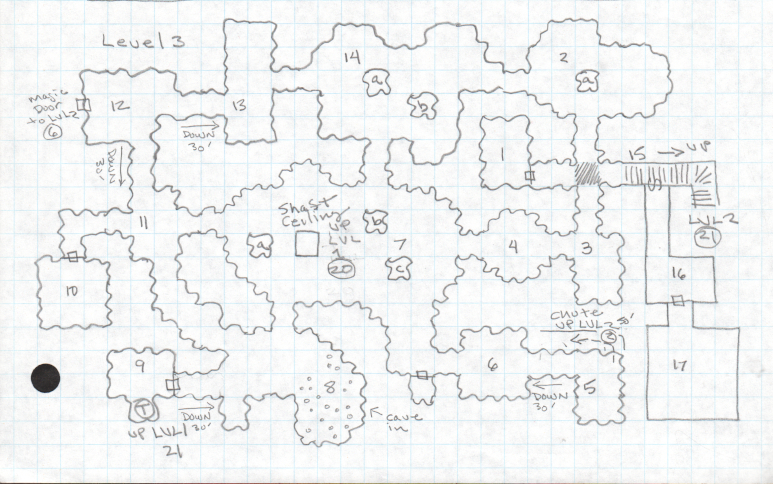
Level 3 Revised Map
It occurs to me that the Players may want to take the Automatons with them out of the Underworld and use them to carry treasure for them. You may or may not decide to allow this. Let’s establish a limit; they can carry up to 1600 coins. For that reason alone we do not want too many of these things! I might say the Automatons stop working once they leave this Underworld and never work again. If you allow the Automatons greater utility beyond this Underworld, once damaged, the Player Characters are certainly incapable of repairing them or re-creating them. We may also propose that having them repaired or re-created is beyond the ability of any but their now long dead makers.
The Players might also decide to use them as proxies to fight for them. This the Automatons do poorly and as we have pointed out they follow instructions badly and attack last in every round. If they get the instruction to attack a monster wrong, 45% of the time, they should drop weapons, stop, and do nothing even when they themselves are attacked.
Map key 1
This room will be a magical clockwork Automaton workshop.
1. Workshop. This area is knee deep in miasma. The door to this room is oxidized green bronze. It is painted with a number, 3, and locked. The inside of this room makes one feel as though they are within a clock. The walls and ceiling are covered in oxidized green bronze moving gears and machinery. They tick, tock, click, and whir.
Secret Ref Info: Every Automaton has a key to the door built into their claw, they can open the door and come in for servicing. The room is a magical clockwork which cleans, lubricates, and replaces broken parts, or it once did, now it is not working so well and has fallen into the same decrepit state as the Automatons themselves. This room will not restore any hit points that Automatons have lost. The parts bins are empty, save for a few bits and pieces. There is one bin with a number of discarded heads. When an Automaton enters this room claws from the machine will restrain it and other instruments will go through the motions of cleaning and servicing. The machine will remove evil possessed heads and place them into a waste bin. Unfortunately it will select and a replacement head from the same bin and there is a 65% chance any alternate head will also be a possessed one if not the same one. It will attempt to remove broken or malfunctioning parts and, as the bins are empty or contain broken parts, will replace them with similarly malfunctioning parts or just re-install them. It does not even re-assemble the Automatons properly 25% of the time. Right and left hands and feet will be swapped, heads will be put on backwards, etc. The Automatons act as if everything is assembled normally and try to continue whatever it is they were doing previously, returning to the map key they came from.
Once an evil possessed head is installed an Automaton becomes an uncontrollable self-determining monster. It no longer takes any instruction, though it may feign compliance, selecting an appropriate moment to betray any man-like Character. It will deliberately choose its time with the most impact, doing something wrong at an inconvenient moment, ringing its bell at inconvenient times to attract wandering monsters, running away, or even attacking. This is an area where you, the Ref can be spontaneous and inventive during the play of the game as you role-play this monster.
Map key 2
This room is knee deep in miasma. The pillar holds up the ceiling. Standing in this room are three motionless Automatons covered in rotting blue sack cloth, painted with yellow numbers 6, 12,and 13 front and back. They carry picks. They face the North wall of the cave.
2. Pillar Room. When anyone enters this room the Automaton’s begin to chime. The chimes means that the Automatons are waiting for instruction.
Secret Ref Info: Check for Wandering Monsters as they may be attracted by the ringing. 3 Decrepit Automatons numbered 6, 12, and 13, Armor Class 7, 3+1* Hit Dice, 14 Hit Points, Move 30/10, claws 1-6 damage or pick 1-8 damage, Save F:3, M12, Alignment Chaotic, not affected by sleep or charm spells and disease. They always attack last in every round. In 1d6 turns their bells ring and they will leave and go to Map Key 1 for servicing. If attacked they defend themselves and will go to Map Key 1 when damaged. Although they may be commanded by any man-like Character they perform any task but mining very poorly 45% of the time. The Automatons misinterpret and apply non-mining instruction in the wrong way, drop, or break items, with the result they do not know what to do next and stop. If two Characters give simultaneous or conflicting directions they do not know what to do next and stop. They can carry up to 1600 coins.
There are a few gemstones and gold nuggets scattered on the floor at their feet but the Automatons have filled the buckets they carry on their backs with valueless rocks. They automatically empty them making the journey at a walk to Map Key 3.
Map key 3
Let us propose that this room is where the Automatons go to dump out their buckets. There is a wooden wheeled mine cart here over-filled with rock which has gone uncollected by the Masters of the Automatons. Valueless rocks have spilled over the floor. Just who these long dead Masters of the Automatons were is currently a mystery to us. We don’t have to solve every puzzle.
3. Storage Room. There is a large wooden mine cart here which is overflowing with rock. It is not so big that at one time it could have been pushed through the mine. It is currently stuck and would have to be dug out as the floor is covered wheel deep in rocks.
Secret Ref Info: The Automatons mindlessly dump out their buckets of valueless rock here. The bin contains nothing real of value.
Map key 4
This map key will contain the remains of smashed Automatons scattered under the knee deep miasma. Lets say that they were smashed by Zombies. We’ll propose a little puzzle here involving the re-assembly of an Automaton. We’ll say there is an “unguarded treasure” here, gemstones, hidden where a pick is stuck in the south wall. This is what we like to call a clue. The Player Characters could mine there and reveal the gemstones themselves or they could let the clockwork in Map Key 1 re-assemble an Automaton which will then return to its work and reveal the gemstones. We won’t put too many more Automatons in the Underworld as we have lots of other monsters we can place from our proposed list.
4. Antechamber. The miasma is knee deep here. There is a pick stuck in the south wall.
Secret Ref Info: Under the mist lay three broken Automatons which the Player Characters will stumble across if they search. There are enough parts to make one working Automaton out of the three and the clockwork in Map Key 1 will assemble a working Automaton out of the wreckage of the three, number 7. We have already decided to have some gemstones in this Level so we will consult our unguarded treasure table in Moldvay on page B52 and roll 1d6 to determine a number appropriate to Level 3, we roll a 4. Let us imagine that the Automaton will then return to its place of work at the south wall of Map Key 4 and continue mining until it reveals the gemstones; we can consult the table in Moldvay on page B47 to determine the potential range of worth and either roll for the value or choose it, lets pick 1000 gp, 500 gp, 100 gp, and 50 gp because after all this is Level 3.
Map key 6
Several poxy Zombies stand knee deep in miasma. They once carried plague but the look of them will scare the Players if they know about the plague. The real threat though is the miasma so their appearance is a bit of a misdirection. We’ll make them a little tougher than the average Zombie by making them 3 hit dice monsters, heh, heh, heh. There is no reason why we can’t do this if we like. We’ll keep their number appearing consistent with three hit dice monsters, consulting the Wandering Monster table in Moldvay on page B54, and looking at monsters of 3* hit dice, lets choose 1-6 rather than the usual 2-8, which should be appropriate. The increase in hit dice, hit points, and improved attack will come as a nasty surprise. The main thing is not to make the encounter overwhelming.
Note that the increase means they are worth more XP!
These creatures were once controlled by the Acolytes of Pestilence and used to mine the rock; they have become even more evil since the Heart of the Cavern was removed.
We’ll say these Zombies are carrying scrolls hidden in the raged remnants of their clothing. We’ll pick the spells from the spell lists and try to give the Players what we think will be most useful. There is nothing that has to be adversarial in the role of the Leader of the Game. We could give some of the lesser used spells but its more fun for the Players if they have something they can apply right away to their adventure. It may come as a surprise but Players have a way of making their own trouble without any help at all!
6. Antechamber. Three silent wretches stand here, knee deep, in miasma. They might once have been alive but Their contorted pox ridden bodies are shrivelled and decaying. They immediately turn and move towards you…
Secret Ref Info: 3 Zombies, Armor Class 8, 3 Hit Dice, 10, 9, 14 Hit Points, Move 120/40, Damage 1-8, Saving Throw F2, M12, Alignment Chaotic, monster description Moldvay page B44, Undead Human, they are slow fighters, and always strike last (no initiative roll needed), make no noise, not affected by Sleep or Charm spells. May be turned by a Cleric.
The Zombies will attack. In their ragged clothes each Zombie carries a scroll:
- Scroll, 3 Cleric Spells: Cure Light Wounds, Protection from Evil, Cure Disease.
- Scroll, 3 Cleric Spells: Detect Evil, Light, Cure Disease.
- Scroll, 3 MU/Elf Spells: Magic Missile, Invisibility, Web.
Map key 8
The ceiling caved in here a long time ago dropping a pile of rubble on top of several Zombies and their Acolyte master(s). This past event is described by the miner’s book at Map Key 16. The already dead Zombies wandered off but their master(s) is(are) an evil undead spirit(s) now. We’ll make this creature a Wight. This is the single most dangerous monster in the entire dungeon!
Wights are creatures that should be used with some care. You may want to recast this with another monster if the players do not have silver or magical weapons. The number is 1-8 in a lair. There should be at least 1, possibly 2. Wights drain Levels of experience and they can only be struck by “silvered” or magical weapons in the Moldvay/Mentzer rules.
- Refer to Moldvay page B44 for the topic Undead and a description of the Wight, the topic Energy Drain page B44, and the topic Oil on page B26.
- The topic Energy Drain in Mentzer’s Dungeon Master’s Rulebook on page 24 is very useful because it gives an example of a Wight’s Energy Drain, however Mentzer introduces the reduction of xp to an intermediate quantity between two Levels – whereas previously all of a Level’s xp were lost. It appears that fire also no longer damages Wights as I could find no mention of it in the topic Oil on page 59. We’ll include this form of attack and put it back into play as part of our Mastery of the Rules.
Player Characters drained of energy are dead and themselves become a Wight in 1-4 days. Why wait? The dead body of a Player Character could be inhabited immediately by our ghastly monster, which can then attack using the Player Character’s own weapons, won’t that be fun!
If we are starting out our Players at 3rd Level, as I suggested in an earlier article, this presents somewhat less of a problem, and Players can scrape by losing a Level or two, but Players will still find this particular monster very challenging to defeat and any loss of Level, spells, and fighting capability will be daunting. Read the topic Energy Drain in Mentzer so that you fully understand the implications of this form of attack. It will put fear into the hearts of the Players!
There is an upside to this monster. Its treasure type is B, refer to Moldvay page B45.
Silver Weapons
As the Leader of the game we have to decide how to interpret the use of the term “silvered” in the context of weapons as they are required to attack supernatural creatures such as Wights. In the text of Moldvay there are many references to “silvered” weapons and the term does not appear in the glossary. Moldvay’s rules are consequently vague as the meaning of “silvered” is never adequately defined.
“Silvered” has often been widely, and apocryphally, interpreted to include weapons dipped into molten silver. The dip never wears off thereafter and from then on the “silvered” requirement is all too often ignored. For a proper context we need to look back to the original rules, and Holmes. both never use the term silvered; instead those older rules specifically refer to “silver weapons” as a requirement to strike certain monsters and the only silver weapon in their equipment lists are silver tipped arrows. “Dipping” is a departure from the canon of the rules and there are instances when we have to look at a house-rule and decide when it is simply a spoiler.
In Moldvay on page B12 we have both a silver dagger and silver tipped arrows. When the text refers to “silvered” weapons my adjudication therefore is that it is only referring to these two specific weapons from the equipment list and “silvered” does not mean anything else. Therefore, beefier weapons that cause more damage, such as swords are not made of silver.
Mentzer’s rules are consistent with Moldvay in that they also use the term “silvered” in a few monster descriptions. However, my impression is that the use of this term is simply a carry over from the text of Moldvay and perhaps an anachronism. Mentzer’s text also lists the silver dagger and silver arrows in the equipment list on page 29 which we find are consistent with the previous rules.
Therefore, when a monster is to be attacked with “silvered” weapons we can take it to mean that a silver dagger or silver tipped arrows are required as there are no other silver weapons in the equipment lists and no other rules. This limitation therefore applies to our Wight and other similar monsters.
What this means in practical terms is that unless players have a magical weapon such as a sword they are limited to the range of 1d4 damage from silver tipped arrows and silver daggers. This makes the Wight and similar creatures a more fearsome opponent and this is likely by design.
Convolutions
I recognize that the above adjudication may not be very popular. We are often tempted to try to “rationalize” our way toward whatever it is we want to do. Our usual go-to is to attempt a treatment of the game as a simulation-of-the-real. This is only natural, the real is our only frame of practical reference but it usually ends up being about as effective as a logical fallacy, mould is grey, clouds are grey, therefore the sky is mouldy. If we treat our game too seriously as a simulation I believe we are really missing something, that when properly regarded as a construction we then recognize the rules themselves are only not a necessary fiction but that they may be properly regarded as necessarily abstract to allow the impossible things within our imagination to occur in the game.
I am far from the sort of person who regards the text of the rules as fixed canon. In fact throughout these articles I have championed agency and there are differences throughout the iterations of the texts. My assessment is that the rules, inspired by literary fiction, interpret supernatural creatures such as the Wight in such a way that they are not invulnerable. No monster should be beyond reach. Part of the fun is always having a chance to succeed!
My wholistic conjecture, having examined the original rules through Mentzer, is that one of the reasons silver weapons exist is because without this rule supernatural monsters such as the Wight could not be attacked without a magic weapon. That would make them impervious to attack in normal melee which wouldn’t be much fun. In this light, the variable damage from the available silver dagger in the equipment list is a half-step from that of a full magical sword. The dagger, for example, gives the player a chance in combat but does not grant the same damage as if the character had a magical sword.
Note – As in the original rules, all weapons in Moldvay cause 1d6 Damage (refer to the topic Damage in Moldvay page B25) so there is no difference between a sword and a silver dagger unless the variable damage table on Page B27 is used. I realize I am skipping over the Greyhawk supplement to the Little Brown Books but I really want to direct your attention to the Moldvay and Mentzer edits. In Mentzer on page 60 of the Players Manual Normal 1d6 and Variable Weapon Damage are treated in the same topic.
Mentzer’s text says:
“so far, your character’s weapon inflicted 1-6 (Id6) points of damage. But if we consider the battle realistically, a dagger should do less damage than a sword”
As you will undoubtedly guess my chief objection would be that the yardstick of the real does not necessarily apply except as perhaps required for suspension of disbelief. We may need aids to help us make a plausible leap into imagination. The entire thing however is an abstract fiction and when we make house rules our eye needs to be not fixed on the real but on how any new rule affects the others in the play of the game. I will graciously yield to the wise sages who preceded me but don’t let yourself be too led astray by the concrete. Keep your eye on the fun!
Both Moldvay and Mentzer drop the special damage rules for silver and magical arrows as found in the text of the original rules and Holmes. Refer to the description of the Wight in Holmes on page 32:
Silver tipped arrows score normal damage and magic arrows double damage against them.
Even bearing in mind the rule was written before the silver daggers were included in the game I think this is still an important one which benefits the players and which could be re-adopted. If you decide to include it write it down as part of your Mastery of the Rules.
Describing Monsters
Before I go further it might be worth emphasizing that when you present a monster to the players you will want to describe what it is like, and not name it! The name, once revealed, may queue player expectations; particularly if they have read the rules. You can take any map key and present it in your own words, you just have to read it first to get a sense of what it is! For example:“You see a Wight” is not at all the same thing as “The ceiling has caved in here and a pair of rotten boots stick out from under the rubble. Undoubtedly some unfortunate soul perished here. You barely take another step when silently, from the body, rises a sickly green luminous mist which takes the form of a glowing spirit with blazing eyes.” The exposition is longer, but it sets a scene, and a mood, ideally contributing to a sense of apprehension. You will quickly get an idea what your Players enjoy. The Players will have no idea what this monster is and you are not immediately compelled by any rule to reveal its name. In the play of the game, you can decide what is common knowledge and what is not and some Non-Player Character, or lore as found in a yet to be discovered book, can name the creature and describe it a little. Players, over-the-game, may understand what the monster is, and what the rules are which define it, but their Characters are as dumb as posts. Division of the two is necessary because knowing the rules around the monsters suspends disbelief and the Player’s immersion in the experience. Quite often Players are themselves and forget to role-play Bowlord the Elf-Warrior!
The Body
The “body” under the rubble is wearing the garments of a Plague Doctor/Acolyte of Pestilence. When approached a glowing immaterial figure with blazing eyes will rise from the body. This doesn’t quite match the description of the evil spirit inhabiting the body per Moldvay/Mentzer but if like me you wonder what actually happens to this “evil spirit” once the body it inhabits is attacked and defeated — well this is left to our imagination. We can assume it is destroyed with the body. I think it is a bit more fun to re-imagine this a little bit. So, we’ll have a glowing evil spirit which can be attacked with silver, or magical weapons, fire, and of course spells.
8. Cave In. The ceiling has fallen here leaving an open dome-like space above the rubble covered floor. A pair of legs ending in rotten boots stick out from under the rubble. Undoubtedly some unfortunate soul perished here. You barely have time to take another step when silently, from the body, rises a sickly green luminous mist which takes the form of a glowing spirit with blazing eyes.
Secret Ref Info: You may decide upon two Wights; if you do so there are two bodies. Each “body” under the rubble is wearing the garments of a Plague Doctor/Acolyte of Pestilence. When approached a glowing immaterial figure with blazing eyes will rise from the body. It is a Wight which can be attacked with silver, or magical weapons, fire, and of course spells. It can only attack with a weapon if it is inhabiting a dead body. We’ll propose that it can inhabit any nearby dead body at will. The body of the Acolyte(s) in the rubble has(have) a mace.
Wight, Armor Class: 5, No. Appearing: 1-6 (1-8), Hit Dice: 3*, 8 Hit Points (and 12 Hit Points if you decide to add a second Wight), Save As: Fighter: 3, Move: 90′ (30′), Morale: 12, Attacks: 1, Damage: weapon + touch, energy drain, Alignment: Chaotic, monster description refer to Moldvay Page B44.
Among the rubble from the ceiling is the treasure this evil spirit has gathered and is hoarding. We could pick an appropriate lair treasure from the table in Moldvay on page B45, roll randomly, or a mixture of the two. We already have an idea of the kind of treasure we intend to place for this Level. This in-lair treasure is in addition to the things we have decided to place and is intended to be a reward commensurate with the difficulty of the monster. We’ll roll randomly on the table and see if the result meets the kind of reward we intend to grant. It’s quite possible that there could be more treasure than the Player Characters could carry away. We must also bear in mind that no Player may advance in Level more than they are allowed by the rules.
In row B (our treasure type), there is a 50% chance of copper coins, we roll 52, nothing. There is a 25% chance of silver coins, we roll 11, we then roll 1d6 x 1000, we roll a 3 x 1000 = 3000 silver coins. There is a 25% chance of electrum coins, we roll 78, nothing. There is a 25% chance of gold coins, we roll 59, nothing. There is no chance of electrum coins, nil. There is a 25% chance of gems and jewelry (and we roll twice once for gems once for jewelry), we roll a 32, 54, nothing, nothing. There is a 10% chance of 1 Sword, Armor, or weapon, we roll 24, nothing. As the leader of the game we are engaged in constructing our Underworld. Do we respect the element of chance and let the dice fall where they may, or not? Once you have decided to use chance let the dice fall where they land and accept the result. Certainly 3000 coins is not much of a reward for such a difficult monster as the Wraith. C’est-la-vie.
We could have taken a different approach from the outset and chosen the treasure outright within the bounds set out in row B of the table. There’s nothing wrong with this approach. The game has to be fun, and there has to be a reward for the Players or they won’t enjoy it. The risk is that you might give away a bit more treasure but if you enforce encumbrance rules it will make the Players sweat about what they can actually carry away and things won’t get out of hand. Any treasure left behind will not be there when the Player Characters return and you can have all sorts of fun with letting them try and track down what monster(s) carried it off and where it might be now.
Had I chosen the treasure the hoard might look like this: 3000 Copper coins, 2000 Silver coins, No Electrum Coins, 1000 Gold Coins, No Platinum, 4 Gems : Ruby 500 gp, Emerald 100 gp, Ruby 50 gp, Ruby 10, gp and 2 Jewelry: Tiara 1400 gp, Bracelet 400 gp, Falcon 900 gp, Cup 700 gp, and 10 +1 Arrows. I simply picked what treasure I wanted and occasionally randomly rolled for the quantity/value per the table.
Map key 10
This is a tomb made in some ancient time. We’ll say it predates everything else. Within were once interned the remains of a then renowned Warrior Priestess and two other warriors of Law Alignment who are now long forgotten. We just made that up.
Miasma cannot enter the tomb while the door is closed. The door will be stone. We’ll say its a sliding slab of stone that descends vertically into a groove in the floor, so it has to be raised, and needs to be propped open or the door will close. What we are getting at here is that it cannot be pushed or pulled and so it is a little puzzle for our Players.
Inside the tomb we’ll have three stone sarcophagus on the west, south and east walls. Each sarcophagus has a stone effigy on top of the person interned within, all are in actuality “Crystal Living Statues” for the purposes of statistics. They depict a Warrior Priestess and two noble companions. Although they are supposed to be made of crystal for our purposes we’ll say they are made of stone, marble.
Crystal Living Statue, Armor Class: 4, No. Appearing: 1-6 (1-8), Hit Dice: 3*, 8, 15, 10 Hit Points, Save As: Fighter: 3, Move: 90′ (30′), Morale: 11, Attacks: 1, Damage: 1-6, Alignment: Lawful, monster description refer to Moldvay Page B37.
Are they guardians? Of a kind. They will rise from their resting place upon the tombs of the Lawful dead to defend the tomb from Chaos, and looters and challenge the Player Characters — What is it that you want here? They will not attack until the Player Characters have demonstrated their intentions to defile the tomb by looting it. This they will not allow. We’ll say the “priestess effigy” is the leader.
As they are lawful, and as part of our alignment test, we’ll propose these statues desire that the Heart of the Cavern be returned to its place and the caverns restored, refer to Map Key 7. To that end in any parley the “Priestess” will tell the Player Characters that the Patriarch Devious Ingrate has taken the ruby and that it must be returned to the niche in the Great Cavern. If the Players perform this the Living Statues will reward them with the contents of the three sarcophagi as they will have proven themselves to be worthy. As in keeping with our previous alignment test we present the Players with a choice to make.
The three living statues, we propose, are magically prevented from leaving this tomb until the ruby is restored to its proper place. Perhaps possessed of the ruby Devious Ingrate was able to force them into it or possibly they took refuge in this lawful place from the ambient chaos so they would not be corrupted by it. The miasma cannot enter this room.
Each sarcophagus contains the following, a skeletonized body and grave goods:
- West, +1 Chain Armor, +1 Shield, Potion of Diminuation, Scroll, 3 Cleric Spells: Cure Light Wounds, Protection from Evil, Cure Disease, 1/2 of a broken rod. We might propose that if re-united with the other half is a Rod of Cancellation or some other magical widget. The search for the missing half is an opportunity for further adventure in this Ruin and Underworld.
- East, +1 Sword, +3 vs. Undead, Ring of Fire Resistance
- South,+1 Leather Armor, +1 Dagger, Rope of Climbing
Each Living Statue is capable of gifting a memory if a Player will accept it:
We’ll just make up some stuff here that explains why the tower is now a ruin and throw in some stuff as potentials for further adventure.
Noble – Clouds gather in the sky above the tower. A hole forms in the sky and a hideous mouth appears. A stone is brought to the parapet, it is marked with a symbol Й. In the hands of the priestess a white light springs forth from the stone and rising upward it closes the hole in the sky. Still, legions of the undead are approaching. “The stone must be hidden or they will capture it”, says the priestess. “We have little time.” The stone is placed in a lined box you take it from the tower and bury it at a dusty crossroads. Returning to the tower you are captured by men in plague masks, one of the Acolytes of Pestilence shouts at you: “Where is the stone?”
Secret Ref Info: The finding of this magical Stone is an opportunity for further adventure.
Noble – A mist, miasma, covers the land below the parapet of a tower. Out of this mist come shambling plague ridden corpses. They climb over one another forming a mound as they try to gain the top of the parapet. You know your doom approaches and though valiant you are overwhelmed when the creatures surmount the parapet. Overcome and subdued by the creatures they drag you over the parapet to their master waiting below, an evil priest, who shouts at you: “Where is the stone?”
Secret Ref Info: The finding of this magical Stone is an opportunity for further adventure. The evil priest is recognized as Devious Ingrate.
Priestess – You are surrounded by the undead. All your defenders have been taken or slain. The undead press at the limits of your magical protection but they cannot cross the magical barrier. There is but one thing remaining you can do. Raising your rod in both hands you break it in two releasing a terrible force which throws back the horde of undead; unfortunately the tower beneath your feet collapses into ruin from the release of the magical energy contained within the rod and you perish in the destruction.
Secret Ref Info: Finding the second part of the magical Rod is an opportunity for further adventure.
10. Sepulchre. Once the door is lifted — You notice that for some reason, the miasma outside this room does not enter it. Inside this room are three stone sarcophagi on the West, East, and South walls, each of which has an effigy, presumably of the person interned within, on its top. They are very lifelike, a warrior priestess and two noble companions. The three effigies on top of the sarcophagi rise and the Warrior Priestess speaks: Halt! What do you want here?
Secret Ref Info: The evil of the miasma is prevented from entering the room due to magic. The Players have an opportunity to parley with the three effigies (Living Crystal Statues). They will not attack until the Player Characters have demonstrated their intentions to defile the tomb by looting it. This they will not allow and they will attack the Player Characters to prevent it.
The three living statues want the Players to restore the Ruby, the heart of the Cavern, to its place. They cannot leave this room until this is accomplished. They will reward the Player Characters from the grave goods in the sarcophagi if they return the ruby to its place in pillar C, thus demonstrating they are worthy, refer to Map Key 7.
Marble Living Statue, Armor Class: 4, No. Appearing: 1-6 (1-8), Hit Dice: 3*, 8, 15, 10 Hit Points, Save As: Fighter: 3, Move: 90′ (30′), Morale: 11, Attacks: 1, Damage: 1-6, Alignment: Lawful, monster description refer to the Living Crystal Statue in Moldvay Page B37.
Each sarcophagus contains the following, a skeletonized body and grave goods:
- West, +1 Chain Armor, +1 Shield, Potion of Diminuation, Scroll, 3 Cleric Spells: Cure Light Wounds, Protection from Evil, Cure Disease, 1/2 of a broken rod. We might propose that if re-united with the other half is a Rod of Cancellation or some other magical widget. The search for the missing half is an opportunity for further adventure in this Ruin and Underworld.
- East, +1 Sword, +3 vs. Undead, Ring of Fire Resistance
- South,+1 Leather Armor, +1 Dagger, Rope of Climbing
Each Living Statue is capable of gifting a memory of the long dead interned Character within their sarcophagus if a Player will accept it:
Map key 11
Although we haven’t placed every monster in our list yet we’ll say that this intersection is empty. We’ll roll on our table to determine if there is anything here.
| Dice Roll | Result |
| 1-2 | Monster, 4-in-6 chance of treasure (dice result 1-4) |
| 2-3 | Empty, 1-in-6 chance of hidden treasure (dice result 1) |
| 4-5 | Trap, 2-in-6 chance it protects treasure (dice result 1-2) |
| 6 | Special, no treasure |
We roll 1d6 and the result is 2, Monster! It would have to be something that can withstand the miasma. There is a 4-in-6 chance of an unguarded treasure, and we roll 5, No Treasure!
We then roll 1d20 on our Wandering Monsters Table, in Moldvay page B54, substitute your rules of choice as appropriate. The result of the dice roll is 1, on the table for Level 3 we look down the Dice Roll column to find 1 and move right in the row to find under the Wandering Monster Column, White Ape. Unfortunately this won’t do as it would be long dead from the miasma and we need something which can endure it. We’ll roll again, 15 Ochre Jelly, perfect! This is a classic! There are only ever one of these creatures and they have no lair and no treasure.
Ochre Jellies are ochre-coloured giant amoebas which Molvay and Mentzer’s rules refine a bit by saying they inflict damage on “exposed flesh”. The implication from this is that the monster takes 1 round to dissolve clothing, leather, etc., but they do not get through metal and stone. The monster can seep through cracks so armor doesn’t make Players invulnerable. The fun part for the Ref is that if attacked with weapons it simply gets split into more Ochre Jellies. Infinitely? You decide. This is a slow monster and Player Characters can run away from it unless they are over-encumbered. We can infer that it will have no interest in stopping for dropped treasure, only food.
We do have a bit of creative license as to how we choose to interpret the attack of this and similar creatures. The text for the Ochre Jelly is a bit deficient in describing how it works. We can refer to Gray Ooze, Moldvay page B36, Mentzer page 31 for an inference as to how Oozes, Jellies and other like monsters should work:
After the first hit, the ooze will stick to its victim, automatically destroying any normal armor and doing 2d8 points of damage each round.
As it takes 1 round for our Ochre Jelly to dissolve clothing, etc., we can assume that with the first successful attack this creature removes barriers of clothing, leather, etc. to gain access to the Character’s flesh. Beginning on the second round the monster then automatically inflicts damage. The rules never specifically state that this occurs automatically but we can infer from the example of Gray Ooze that this is likely the case. Of course our Jelly does not damage metal armor but will get through leather armor and shields in one round. Wait says the Player, I’m wearing a shirt! Do layers matter? Probably not. In any event we’ll rule no, and write down our decision.
11. Intersection. There is a yellow-ish blob of something disgusting slithering over the floor here.
Secret Ref Info: The Ochre Jelly slithers towards Players and attacks. The first attack is presumed to penetrate clothing, leather, etc.
Ochre Jelly, Armor Class: 8, No. Appearing: 1 (0), Hit Dice: 5*, 18 Hit Points, Save As: Fighter: 3, Move: 30′ (10′), Morale: 12, Attacks: 1, Damage: 2-12, Alignment: Neutral. For a description of this monster refer to Moldvay page B40, Mentzer page 35. After the first hit, the Ochre Jelly will stick to its victim, automatically destroying any leather armor, wood shields, and clothing doing 2d8 points of damage each round. This monster can seep through cracks, destroys wood, leather, and cloth in 1 round. It cannot destroy metal or stone, including a Player Character’s armor. Attacks with weapons (or lightning) make 2-5 (1d4+1) 2 Hit Dice Ochre Jellies. These cause 1/2 their normal damage; roll 2d6 and divide the result in half, round down. The monster is damaged by cold and fire.
Map key 13
We’ll make this room a place where a Player can mine the rock for rubies. We’ll borrow some ad-hoc mining rules from Gloomland.
13. Ruby Mine. This room appears to be empty, the floor is knee deep in miasma.
Secret Ref Info: Gemstones are found in cave areas underground. Where there is a gemstone resource to be mined it may be discovered 2-in-6 by a Dwarf if they are searching as unusual stonework.
There are 4+1d6 gemstones to be mined. Roll on the Gems table to assign the value of each gemstone.
A pick must be used. They must be mined in sequence e.g. there are 9 gemstones to be extracted (1 per Turn) with a value of 10, 100, 100, 500, 100, 25, 250, 50, 50 gp.
The sound of mining may 2-in-6 attract wandering monsters each turn.
Precious metals may be discovered and mined in the same way. Roll 1d6 to determine the vein type; 1-2 copper, 3 silver, 4 gold, 5 Electrum or 6 Platinum. A single vein will have a value of (4+6) x100 coins (weight).
Map key 14
The ceiling of this room is held up by two pillars, (a) and (b). It is the lair of two Tarantella Spiders.
14. Storage Room. Under the knee high mist the floor of this room is a graveyard of Automatons. The floor is covered with clockworks and bits of twisted metal.
Secret Ref Info: Opposite to the entrances of this room two Tarantella Spiders cling to the North sides of Pillars (a) and (b).
If the Player Characters are noisy, or show a light, the spiders will move before the Player Characters enter the cave to the opposite side of the pillars from the entrance of approach, from which they cannot be spotted. These unseen spiders may surprise Player Characters. Light negates the chance of Characters surprising the spiders but not the other way around!
If the Player Characters are quiet, and/or do not show a light, the spiders do not move and there is a 2-in-6 chance that at least one can be spotted clinging to the north side of the pillars from the West (a) or East (b) entrance. The spotted spider cannot surprise the Player Characters. If Player Characters enter quietly, and without light, from the south the two spiders cannot be detected. Unseen spiders may surprise the Player Characters.
Tarantella Spider, Armor Class: 4, No. Appearing: 1 (0), Hit Dice: 4*, 14, 9 Hit Points, Save As: Fighter: 2, Move: 120′ (40′), Morale: 8, Attacks: 1, Damage: 1-8 + Poison, Alignment: Neutral. For a description of this monster refer to Moldvay page B43, Mentzer page 38. When a bitten Character fails their saving throw vs. poison they painfully and involuntarily dance which grants the spider +4 to attack dice rolls. A-4 dice roll modifier is applied to a poisoned Character’s to-hit rolls. The effect of the spider’s bite lasts 2-12 Turns. Dancers collapse and are helpless in 5 Turns. Observers, those Characters able to see the dancing one, must successfully save vs. spells or they too start to dance uncontrollably in the same way, and for as long, as the original victim.
How can we expect to implement this? Example: Lindy the Lucky is bitten by a Tarantella Spider and fails their saving throw vs. poison. The Ref rolls 2d6 and gets a 7 which means Lindy will dance for 7 turns. Lindy begins to dance uncontrollably and will collapse in 5 Turns after which the Spider can expect to attack Lindy without retaliation. In the meantime the other Players in the party can all see Lindy and they must all save vs. spells or they too will have to dance for 7 Turns. Some pass and some fail. The spiders can attack dancing Characters gaining a +4 dice roll modifier, example: if they roll a 7 add +4, sum and the result is 11, which may or may not indicate success. The dancing Players deduct -4 from their attack dice rolls, if they roll 14 subtract -4, the result is 10, which may or may not indicate success. All dancing Player Characters collapse in 5 turns. The spiders may , instinctively, attack non-dancing Characters but that is completely at the discretion of the Ref.
We have decided that this is a lair. Scattered among the bits of clockwork on the floor is the following treasure type U which is treasure per individual monster; so we will roll twice in each column, once for each spider:
Consulting the table of Individuals’ Treasure Type in Moldvay on page B46, there is a 10% chance of copper coins, we roll 41, 82, nothing. There is a 10% chance of silver coins, we roll 01, 16, roll d100 to determine the number of coins, 15 silver coins, and nothing for one spider. There are no electrum coins. There is a 5% chance of gold coins, we roll 77, 13, nothing. There are no platinum coins, There is a 5% chance of gems and jewelry, and we roll twice here, we roll 98, 28, 15, and 32, nothing. Finally there is a 2% chance of any magic item, we roll 58, 50. Well, that’s a pretty dismal result. We’ll throw in a Potion of Diminuation, and a Ring of Weakness from our planted treasure list, and 85 gold coins.
Map key 7
At this point you’re probably wondering about the closet in the south of Map Key 7. I admit to forgetting about it. We’ll do something with it now. It’s empty. Red herring anyone?
7. Great Cave, addendum – the Closet. There is a wooden door here and the door has a padlock. It is also bound with chains to keep it shut.
Secret Ref Info: This closet is empty. Save for a clay pot here with a lid which is stuck shut that takes considerable effort to remove, A STR check roll can be used to pry off the lid without breaking the pot. This in turn releases a black cloud of harmless but noxious fumes, it’s a chamber pot. The character opening the pot must make a successful saving throw vs. poison or have their prime attribute reduced to 3 for 1d6 Turns. Characters lose their abilities granted by their prime attribute during this period, saving throws and dice roll modifier penalties may be affected, etc.
Collation of Level 3
At this point we can put all of our Map Keys together in sequence.
We will also make a special wandering monster table for Level 3 in view of the miasma. We could use the standard wandering monster table but as long as the miasma is present we’ll use a custom table.
Miasma
A good part of this level is filled knee deep with a mysterious pestilential miasma, which requires the Player Characters to wear the protective garments of Plague Doctors until they replace the Heart of the Caverns in its place. If the Player Characters do not wear the Plague Doctor garments, mask, gloves, hat and shift, or remove a part of it, then they risk falling ill from disease as a result.
Undead and Insect Monsters are not affected by the miasma , nor are Jellys and Slimes, but other living creatures suffer the same fate as Characters.
The miasma (gas) carries disease, like a rat, refer to Moldvay page B41. Anyone not wearing the Plague Doctor garments in the presence of the miasma has a 1 in 20 chance of being infected (this chance should be checked each time a character removes a part of the garments). The victim may still avoid the disease by making a saving throw vs. Poison. If failed, the victim will either die in 1-6 (1d6) days, otherwise the victim will be sick in bed (unable to adventure) for one month. Roll 1d4: the disease is only deadly on a result of 1. You can change this to 1-in-8, or 1-in-10 if you would prefer to reduce the chance of death.
Example: Unlucky Fingers has seen a warning and is wearing the Plague Doctor garments found on Level 2 but removes the mask to sniff the air thus exposing the Character to the pestilential miasma. The Player must make a successful saving throw vs. Poison to avoid the disease, Fingers is a 2nd Level Thief so must roll 13 or better, refer to Moldvay page B26 (or the rules of your choice). The Player rolls 10, failure! This means there is a 1-in-4 chance Fingers will fall ill and die in 1d6 days, or become bedridden for a month and unable to go on adventures. The Character will be bedridden for a month if they do not die in the first 6 days. Fingers becomes bedridden and cannot adventure for 28, 30, or 31 days. Roll the d6 to determine on which day to check and see if the character dies in the first six days from the disease. It can be common knowledge that a living Character who contracts the pox/plague often perishes in less than a week. On the day in question I’d tell the Player, roll a d4 (or d8/d10) and if you get a 1 your Character dies from the plague, if not they are sick and bedridden and cannot adventure until you are cured.
How soon does this illness start? At a minimum allow at least 24 hours to pass before the character breaks out in a pox to show the start of the disease. Can other characters catch this plague from the sick one? Not as long as they wear the Plague Doctor garments.
Diseases can be cured with the 3rd Level Cleric spell, Cure Disease, refer to the Cook/Marsh Expert Rules page X12. Clerics do not gain access to this spell until 6th Level which means that a diseased Character’s only hope is chance or, a Non-Player Cleric willing to perform this service for a tithe, or a scroll with the spell on it which even then only a Cleric may read.
Map key 1
1. Workshop. This area is knee deep in miasma. The door to this room is oxidized green bronze. It is painted with a number, 3, and locked. The inside of this room makes one feel as though they are within a clock. The walls and ceiling are covered in oxidized green bronze moving gears and machinery. They tick, tock, click, and whir.
Secret Ref Info: Every Automaton has a key to the door built into their claw, they can open the door and come in for servicing. The room is a magical clockwork which cleans, lubricates, and replaces broken parts, or it once did, now it is not working so well and has fallen into the same decrepit state as the Automatons themselves. This room will not restore any hit points that Automatons have lost. The parts bins are empty, save for a few bits and pieces. There is one bin with a number of discarded heads. When an Automaton enters this room claws from the machine will restrain it and other instruments will go through the motions of cleaning and servicing. The machine will remove evil possessed heads and place them into a waste bin. Unfortunately it will select and a replacement head from the same bin and there is a 65% chance any alternate head will also be a possessed one if not the same one. It will attempt to remove broken or malfunctioning parts and, as the bins are empty or contain broken parts, will replace them with similarly malfunctioning parts or just re-install them. It does not even re-assemble the Automatons properly 25% of the time. Right and left hands and feet will be swapped, heads will be put on backwards, etc. The Automatons act as if everything is assembled normally and try to continue whatever it is they were doing previously, returning to the map key they came from.
Once an evil possessed head is installed an Automaton becomes an uncontrollable self-determining monster. It no longer takes any instruction, though it may feign compliance, selecting an appropriate moment to betray any man-like Character. It will deliberately choose its time with the most impact, doing something wrong at an inconvenient moment, ringing its bell at inconvenient times to attract wandering monsters, running away, or even attacking. This is an area where you, the Ref can be spontaneous and inventive during the play of the game as you role-play this monster.
Map key 2
2. Pillar Room. This room is knee deep in miasma. The pillar holds up the ceiling. Standing in this room are three motionless Automatons covered in rotting blue sack cloth, painted with yellow numbers 6, 12,and 13 front and back. They carry picks. They face the North wall of the cave.
Secret Ref Info: When anyone enters this room the Automaton’s begin to chime. The chimes means that the Automatons are waiting for instruction. Check for Wandering Monsters as they may be attracted by the ringing. 3 Decrepit Automatons numbered 6, 12, and 13, Armor Class 7, 3+1* Hit Dice, 14 Hit Points, Move 30/10, claws 1-6 damage or pick 1-8 damage, Save F:3, M12, Alignment Chaotic, not affected by sleep or charm spells and disease. They always attack last in every round. In 1d6 turns their bells ring and they will leave and go to Map Key 1 for servicing. If attacked they defend themselves and will go to Map Key 1 when damaged. Although they may be commanded by any man-like Character they perform any task but mining very poorly 45% of the time. The Automatons misinterpret and apply non-mining instruction in the wrong way, drop, or break items, with the result they do not know what to do next and stop. If two Characters give simultaneous or conflicting directions they do not know what to do next and stop. They can carry up to 1600 coins.
There are a few gemstones and gold nuggets scattered on the floor at their feet but the Automatons have filled the buckets they carry on their backs with valueless rocks. They automatically empty them making the journey at a walk to Map Key 3.
Map key 3
3. Storage Room. There is a large wooden mine cart here which is overflowing with rock. It is not so big that at one time it could have been pushed through the mine. It is currently stuck and would have to be dug out as the floor is covered wheel deep in rocks.
Secret Ref Info: The Automatons mindlessly dump out their buckets of valueless rock here. The bin contains nothing real of value.
Map key 4
4. Antechamber. The miasma is knee deep here. There is a pick stuck in the south wall.
Secret Ref Info: Under the mist lay three broken Automatons which the Player Characters will stumble across if they search. There are enough parts to make one working Automaton out of the three and the clockwork in Map Key 1 will assemble a working Automaton out of the wreckage of the three, number 7. We have already decided to have some gemstones in this Level so we will consult our unguarded treasure table in Moldvay on page B52 and roll 1d6 to determine a number appropriate to Level 3, we roll a 4. Let us imagine that the Automaton will then return to its place of work at the south wall of Map Key 4 and continue mining until it reveals the gemstones; we can consult the table in Moldvay on page B47 to determine the potential range of worth and either roll for the value or choose it, lets pick 1000 gp, 500 gp, 100 gp, and 50 gp because after all this is Level 3.
Map key 5
5. Cave. This cave is elevated above those below by 30’. A steep passage leads west. Above the door is a wooden sign upon which, painted in yellow, are crudely painted crossbones and the words Danger Miasma.
Secret Ref Info: This room is the exit of the chute from Level 2 Map Key 2. The sign was painted by the miners. At the bottom of the sloped passage can be seen a fog hanging close to the floor, miasma. This room is a little higher and that the western passages slope downward we’ll say that at the bottom of the passage the foggy cloud of miasmic gas clings to the floor of map key 6. Should the player characters descend to the adjacent map key 6 without the necessary protective clothing they will expose themselves to the miasma.
Map key 6
6. Antechamber. Three silent wretches stand here, knee deep, in miasma. They might once have been alive but Their contorted pox ridden bodies are shrivelled and decaying. They immediately turn and move towards you…
Secret Ref Info: 3 Zombies, Armor Class 8, 3 Hit Dice, 10, 9, 14 Hit Points, Move 120/40, Damage 1-8, Saving Throw F2, M12, Alignment Chaotic, monster description Moldvay page B44, Undead Human, they are slow fighters, and always strike last (no initiative roll needed), make no noise, not affected by Sleep or Charm spells. May be turned by a Cleric.
The Zombies will attack. In their ragged clothes each Zombie carries a scroll:
- Scroll, 3 Cleric Spells: Cure Light Wounds, Protection from Evil, Cure Disease.
- Scroll, 3 Cleric Spells: Detect Evil, Light, Cure Disease.
- Scroll, 3 MU/Elf Spells: Magic Missile, Invisibility, Web.
Map key 7
7. Great Cave. The view from the cave floor. The cave is dark, it’s ceiling is not visible as it is beyond the reach of lanterns and torches. The floor of the cave is covered in a heavy knee deep fog and rising from this are waist high stony fungi and foliage. Periodically the stony fungi make a puffing sound and emit a cloud of fog (miasma). Every step crackles and tinkles underfoot as the floor is covered in shards. Water occasionally drips from the dark above you landing with an audible plop.
The view from the shaft from Level 1. The cave is dark, it’s floor is not visible as it is beyond the reach of lantern light. The ceiling of the cave is covered with dripping stalactites. There is a wooden sign upon which, painted in yellow, are crudely painted crossbones and the words Danger Miasma Below. (If the Player Characters lower themselves on a rope below the level of the ceiling a pillar just to the west is revealed – a great pillar descends into the darkness below you.)
Secret Ref Info: At the bottom of the cave can be seen a fog hanging close to the floor, miasma. Should the player characters descend to the floor of this cave, or enter it, without the necessary protective clothing they will expose themselves to the miasma.
The ceiling of this cave is covered with stalactites. The ceiling cannot be illuminated from the floor by a lantern. Water drips from the stalactites, whenever characters enter a square they have a 1-in-8 chance of being struck, it is poison which when consumed causes damage the reverse of a cure light wounds spell, damage 2-7 (1d6+1) hit points; a successful saving throw vs. poison avoids the damage. Shields may be held like umbrellas to shield a player from the water. Wearing the garments of a Plague Doctor also protects characters from the poison.
A swarm of Carnivorous Flies (Robber Flies) fly about in the dark, attracted to light they will attack 1-6 rounds after player characters shine a light in the cavern, they will fly within 30’ and jump to attack from shadow thus surprising on a 4-in-6. 5 Carnivorous Flies (Robber Flies), Armor Class 6, 2 Hit Dice, 6, 6, 8, 3, 10 Hit Points, Move 90/30 Fly 180/60, Damage 1d8, Saving Throw F1, M8, Alignment Neutral, monster description Moldvay page B41, Labyrinth Lord page 75. They can fly into the shaft and climb on the walls. These monsters are patterned similarly to bees and immune to poison.
Pillar (a) Fountain of pain – When the bottom of this pillar is approached the sound of running water can be heard. In a niche on the west side there is a fountain which endlessly and magically fills a small basin and though the water never seems to drain away it never spills over. The water is currently a poison which when consumed causes damage the reverse of a cure light wounds spell, damage 2-7 (1d6+1) hit points; a successful saving throw vs. poison avoids the damage. If the heart of the Cavern is restored to its place this water restores damage and cures paralysis as if it were a cure light wounds spell, 2-7 (1d6+1) lost hit points are restored. This only works once per character once per day. Drinking a second time merely quenches thirst. It would take 3 rounds to fill a flask.
When the player characters approach the base of this pillar (within 30’ in any direction) check for surprise. Tiger Beetles are 4’ long and most of their bodies are concealed by the miasmic fog until they attack, grant an additional +1 to surprise rolls. When these creatures are observed the Player Characters will see the curved striped backs of insects moving through the knee high fog. It billows in their wake. These aggressive creatures attack; they are lairing here and (imagining their behaviour) have laid a cluster of eggs around the foot of the pillar. The mace (which has the name “SMITER” forged in it) lays among the eggs. 4 Tiger Beetles, Armor Class 3, 3+1 Hit Dice, 10, 10, 6, 11 Hit Points, Move 150/50, Bite 2d6, Saving Throw F1, M9, Alignment Neutral, description Moldvay page B31. Treasure: a +1 mace lies on the floor. The eggs are harmless and can be crushed. If left they will be scavanged by other monsters but a few might hatch and later become formidable beetles in their own right.
Pillar (b) This pillar, though stone, is moist and slick with poison which courses and pulsates through veins in the rock as though it were a living thing. Striking the pillar with a weapon causes it to spray poison at the attacker, which causes damage the reverse of a cure light wounds spell, damage 2-7 (1d6+1) hit points; a successful saving throw vs. poison avoids the damage. These veins in the rock, like roots, extend through the ceiling and floor. It is from these that the poison in the ceiling drips. When the ruby the Heart of the Cavern is replaced this pillar becomes inert rock once more.
Pillar (c) This pillar contains a niche which once held the ruby the Heart of the Cavern. The ruby fits exactly in the spot and if replaced here magically: illuminates the caves, changes the water so it is not poison, brings all the fungi back to life, and clears the miasma.
Note – in our previous article I referred to this as pillar 3” (what was I thinking?) so we will have to amend our text for Level 2 Map Key 17.
Carrion Crawlers have made this pillar their lair and they lurk in the darkness above. When the pillar is approached these creatures run down the pillar and attack.
3 Carrion Crawlers, Armor Class 7, 3+1*Hit Dice, 13, 14, 12 Hit Points, Move 120/40, Damage Paralysis, Saving Throw F2, M9, Alignment Neutral, monster description Moldvay page B32, This monster is worm-like, 9′ long with lots of legs. Its mouth is surrounded by 8 paralysing tentacles, all 2′ long. The attack of this creature paralyzes for 2-8 turns on a successful hit unless a saving throw vs. Paralysis is made. The Carrion Crawler will stop and eat its defenceless paralysed prey unless it is attacked. The paralysis can be removed with a cure light wounds spell. These monsters have stuck their treasure into crevices in the rock of the pillar 30’ feet above (the glint of gold and silver coins can be seen at the edge of lantern light) 4000 sp, 2000 gp, 6 gems (rubies) 10 gp, 10 gp, 10 gp, 50 gp, 50 gp, 100 gp. The player characters will have to climb in order to retrieve the treasure and this activity will take a number of turns to complete.
Closet to the west of Map Key 6
There is a wooden door here and the door has a padlock. It is also bound with chains to keep it shut.
Secret Ref Info: This closet is empty. Save for a clay pot here with a lid which is stuck shut that takes considerable effort to remove, A STR check roll can be used to pry off the lid without breaking the pot. This in turn releases a black cloud of noxious fumes, it’s a chamber pot. Not even the plague doctor mask can protect the affected character. The character opening the pot must make a successful saving throw vs. poison or have their prime attribute temporarily reduced to 3 for 1d6 Turns. Characters lose any abilities granted by their prime attribute during this period, saving throws and dice roll modifier penalties may be affected, etc.
Map key 8
8. Cave In. The ceiling has fallen here leaving an open dome-like space above the rubble covered floor. A pair of legs ending in rotten boots stick out from under the rubble. Undoubtedly some unfortunate soul perished here. You barely have time to take another step when silently, from the body, rises a sickly green luminous mist which takes the form of a glowing spirit with blazing eyes.
Secret Ref Info: You may decide upon two Wights; if you do so there are two bodies. Each “body” under the rubble is wearing the garments of a Plague Doctor/Acolyte of Pestilence. When approached a glowing immaterial figure with blazing eyes will rise from the body. It is a Wight which can be attacked with silver, or magical weapons, fire, and of course spells. It can only attack with a weapon if it is inhabiting a dead body. We’ll propose that it can inhabit any nearby dead body at will. The body of the Acolyte(s) in the rubble has(have) a mace. Player Characters drained of energy are dead and themselves become a Wight in 1-4 days. Why wait? The dead body of a Player Character could be inhabited immediately by our ghastly monster, which can then attack using the Player Character’s own weapons, won’t that be fun!
Wight, Armor Class: 5, No. Appearing: 1-6 (1-8), Hit Dice: 3*, 8 Hit Points (and 12 Hit Points if you decide to add a second Wight), Save As: Fighter: 3, Move: 90′ (30′), Morale: 12, Attacks: 1, Damage: weapon + touch, energy drain, Alignment: Chaotic, monster description refer to Moldvay Page B44.
Among the rubble from the ceiling is the treasure this evil spirit has gathered and is hoarding: 3000 Copper coins, 2000 Silver coins, No Electrum Coins, 1000 Gold Coins, 4 Gems : Ruby 500 gp, Emerald 100 gp, Ruby 50 gp, Ruby 10, gp and 2 Jewelry: Tiara 1400 gp, Bracelet 400 gp, Bejeweled Falcon 900 gp, Bejeweled Cup 700 gp, and 10 +1 Arrows.
Map key 9
9. The Cave. This small cave has a lit red candle floating in the air of the southern niche illuminating much of this room. There is an iron door in the east which has a small rectangular open grille of iron bars at face height. Above the door, is a wooden sign upon which, painted in yellow, are crudely painted crossbones and the words Danger Miasma. A short steep passage descends 30’ and the end is covered in a heavy knee deep fog.
Secret Ref Info: The lit and glowing candle floating in mid air cannot be touched, it marks an invisible teleportal to Level 1 Map Key 21. The candle burns but is not consumed. The easternmost door is made of iron and locked; there is a keyhole. The iron door cannot be opened without the key except with magic or unless it is picked. If the grille in the door is peered through characters can see more cave beyond the short passage, Map Key 8.
Map key 10
10. Sepulchre. There is a door here but it has no handle or obvious means of opening. It is simply a slab of stone.
Secret Ref Info: This is a tomb. It has a sliding door that descends vertically into a groove in the floor so it has to be raised, and needs to be propped open or the door will close. It cannot be pushed or pulled open. Once the door is lifted — the player characters notice that for some reason, the miasma outside this room does not enter it. Inside this room are three stone sarcophagi on the West, East, and South walls, each of which has a marble effigy, presumably of the person interned within, on its top. They are very lifelike, a warrior priestess and two noble companions. The three effigies on top of the sarcophagi rise and the Warrior Priestess speaks to the characters: Halt! What do you want here?
The evil of the miasma is prevented from entering the room due to magic. The Players have an opportunity to parley with the three effigies (Living Crystal Statues). They will not attack until the Player Characters have demonstrated their intentions to defile the tomb by looting it. This they will not allow and they will attack the Player Characters to prevent it.
As they are lawful, and as part of our alignment test, these statues desire that the Heart of the Cavern be returned to its place and the caverns restored, refer to Map Key 7. To that end in any parley the “Priestess” will tell the Player Characters that the Patriarch Devious Ingrate has taken the ruby and that it must be returned to the niche in the Great Cavern. If the Players perform this the Living Statues will reward them with the contents of the three sarcophagi as they will have proven themselves to be worthy. As in keeping with our previous alignment test we present the Players with a choice to make. The three living statues cannot leave this room until this is accomplished.
Marble Living Statue, Armor Class: 4, No. Appearing: 1-6 (1-8), Hit Dice: 3*, 8, 15, 10 Hit Points, Save As: Fighter: 3, Move: 90′ (30′), Morale: 11, Attacks: 1, Damage: 1-6, Alignment: Lawful, monster description refer to the Living Crystal Statue in Moldvay Page B37.
Each sarcophagus contains the following, a skeletonized body and grave goods:
- West, +1 Chain Armor, +1 Shield, Potion of Diminuation, Scroll, 3 Cleric Spells: Cure Light Wounds, Protection from Evil, Cure Disease, 1/2 of a broken rod. If re-united with the other half is a magical Rod of Cancellation or some other magical widget. The search for the missing half is an opportunity for further adventure in this Ruin and Underworld.
- East, +1 Sword, +3 vs. Undead, Ring of Fire Resistance
- South,+1 Leather Armor, +1 Dagger, Rope of Climbing
Each Living Statue is capable of bestowing a memory of the long dead interned Character within their sarcophagus if a Player will accept it:
Noble – Clouds gather in the sky above the tower. A hole forms in the sky and a hideous mouth appears. A stone is brought to the parapet, it is marked with a symbol Й. In the hands of the priestess a white light springs forth from the stone and rising upward it closes the hole in the sky. Still, legions of the undead are approaching. “The stone must be hidden or they will capture it”, says the priestess. “We have little time.” The stone is placed in a lined box you take it from the tower and bury it at a dusty crossroads. Returning to the tower you are captured by men in plague masks, one of the Acolytes of Pestilence shouts at you: “Where is the stone?”
Secret Ref Info: The finding of this magical Stone is an opportunity for further adventure.
Noble – A mist, miasma, covers the land below the parapet of a tower. Out of this mist come shambling plague ridden corpses. They climb over one another forming a mound as they try to gain the top of the parapet. You know your doom approaches and though valiant you are overwhelmed when the creatures surmount the parapet. Overcome and subdued by the creatures they drag you over the parapet to their master waiting below, an evil priest, who shouts at you: “Where is the stone?”
Secret Ref Info: The finding of this magical Stone is an opportunity for further adventure. The evil priest is recognized as Devious Ingrate if the Player Characters have met it.
Priestess – You are surrounded by the undead. All your defenders have been taken or slain. The undead press at the limits of your magical protection but they cannot cross the magical barrier. There is but one thing remaining you can do. Raising your rod in both hands you break it in two releasing a terrible force which throws back the horde of undead; unfortunately the tower beneath your feet collapses into ruin from the release of the magical energy contained within the rod and you perish in the destruction.
Secret Ref Info: Finding the second part of the magical Rod is an opportunity for further adventure.
Map key 11
11. Intersection. There is a yellow-ish blob of something disgusting slithering over the floor here.
Secret Ref Info: The Ochre Jelly slithers towards Players and attacks. The first attack is presumed to penetrate clothing, leather, etc.
Ochre Jelly, Armor Class: 8, No. Appearing: 1 (0), Hit Dice: 5*, 18 Hit Points, Save As: Fighter: 3, Move: 30′ (10′), Morale: 12, Attacks: 1, Damage: 2-12, Alignment: Neutral. For a description of this monster refer to Moldvay page B40, Mentzer page 35. After the first hit, the Ochre Jelly will stick to its victim, automatically destroying any leather armor, wood shields, and clothing doing 2d8 points of damage each round. This monster can seep through cracks, destroys wood, leather, and cloth in 1 round. It cannot destroy metal or stone, including a Player Character’s armor. Attacks with weapons (or lightning) make 2-5 (1d4+1) 2 Hit Dice Ochre Jellies. These cause 1/2 their normal damage; roll 2d6 and divide the result in half, round down. The monster is damaged by cold and fire.
Map key 12
12. Cave. This cave is elevated above those below by 30’. Steep passages lead south and east. Above each door, is a wooden sign upon which, painted in yellow, are crudely painted crossbones and the words Danger Miasma.
Secret Ref Info: This room is the exit of the magic door from Level 2 Map Key 6. It must work in two directions. The signs were painted by the miners. At the bottom of the sloped passages can be seen a fog hanging close to the floor, miasma. Should the player characters descend to the adjacent map keys, 11 and 13 without the necessary protective clothing they will expose themselves to the miasma.
Map key 13
13. Ruby Mine. This room appears to be empty, the floor is knee deep in miasma.
Secret Ref Info: We’ll make this room a place where a Player can mine the rock for rubies. Gemstones are found in cave areas underground. Where there is a gemstone resource to be mined it may be discovered 2-in-6 by a Dwarf if they are searching as unusual stonework.
There are 4+1d6 gemstones to be mined. Roll on the Gems table to assign the value of each gemstone.
A pick must be used. They must be mined in sequence e.g. there are 9 gemstones to be extracted (1 per Turn) with a value of 10, 100, 100, 500, 100, 25, 250, 50, 50 gp.
The sound of mining may 2-in-6 attract wandering monsters each turn.
Precious metals may be discovered and mined in the same way. Roll 1d6 to determine the vein type; 1-2 copper, 3 silver, 4 gold, 5 Electrum or 6 Platinum. A single vein will have a value of (4+6) x100 coins (weight).
Map key 14
14. Storage Room. Under the knee high mist the floor of this room is a graveyard of Automatons. The floor is covered with clockworks and bits of twisted metal.
Secret Ref Info: The ceiling of this room is held up by two pillars, (a) and (b). Opposite to the entrances of this room two Tarantella Spiders cling to the North sides of Pillars (a) and (b).
If the Player Characters are noisy, or show a light, the spiders will move before the Player Characters enter the cave to the opposite side of the pillars from the entrance of approach, from which they cannot be spotted. These unseen spiders may surprise Player Characters. Light negates the chance of Characters surprising the spiders but not the other way around!
If the Player Characters are quiet, and/or do not show a light, the spiders do not move and there is a 2-in-6 chance that at least one can be spotted clinging to the north side of the pillars from the West (a) or East (b) entrance. The spotted spider cannot surprise the Player Characters. If Player Characters enter quietly, and without light, from the south the two spiders cannot be detected. Unseen spiders may surprise the Player Characters.
Tarantella Spider, Armor Class: 4, No. Appearing: 1 (0), Hit Dice: 4*, 14, 9 Hit Points, Save As: Fighter: 2, Move: 120′ (40′), Morale: 8, Attacks: 1, Damage: 1-8 + Poison, Alignment: Neutral. For a description of this monster refer to Moldvay page B43, Mentzer page 38. When a bitten Character fails their saving throw vs. poison they painfully and involuntarily dance which grants the spider +4 to attack dice rolls. A-4 dice roll modifier is applied to a poisoned Character’s to-hit rolls. The effect of the spider’s bite lasts 2-12 Turns. Dancers collapse and are helpless in 5 Turns. Observers, those Characters able to see the dancing one, must successfully save vs. spells or they too start to dance uncontrollably in the same way, and for as long, as the original victim.
How can we expect to implement this? Example: Lindy the Lucky is bitten by a Tarantella Spider and fails their saving throw vs. poison. The Ref rolls 2d6 and gets a 7 which means Lindy will dance for 7 turns. Lindy begins to dance uncontrollably and will collapse in 5 Turns after which the Spider can expect to attack Lindy without retaliation. In the meantime the other Players in the party can all see Lindy and they must all save vs. spells or they too will have to dance for 7 Turns. Some pass and some fail. The spiders can attack dancing Characters gaining a +4 dice roll modifier, example: if they roll a 7 add +4, sum and the result is 11, which may or may not indicate success. The dancing Players deduct -4 from their attack dice rolls, if they roll 14 subtract -4, the result is 10, which may or may not indicate success. All dancing Player Characters collapse in 5 turns. The spiders may , instinctively, attack non-dancing Characters but that is completely at the discretion of the Ref.
Scattered among the bits of clockwork on the floor is the following treasure: 15 silver coins, 85 gold coins, a Potion of Diminuation, and a Ring of Weakness.
Map key 15
15. Stair and Intersection. The ceiling drips, water trickles down the stairwell which descends into darkness. There are tracks on the floor here which come from the stairway and the level below. There is a knee high fog at the foot of the stair, which obscures the floor. A human body lays here on the stair above the fog, a dark lantern lays on the step above its head, an Acolyte of Pestilence whose mask and gloves are missing. The withered face and hands of the Acolyte are covered with pox and in one clawed hand is a vellum scroll, in the other is a quill. Nearby a bottle of ink has been spilled.
Secret Ref Info: An INT attribute check roll can be used to follow the tracks, it looks like a large multi-legged creature crawled up the stair. The tracks belong to the Carrion Crawler in Level 2 Map Key 27 but the players won’t know what they are unless they have seen one before. For Level 3 the tracks lead North into Map Key 2, and West to Map Key 14. They are on the floor, walls, and ceiling.
The deceased Acolyte is wearing plate armor under which are mottled and stained brown cowhide garments and gloves. The beaked leather mask of a plague doctor is missing. A mace lays on the step. In a bag tied to the waist are 10 gold coins. In a back pack are quills, a bottle of ink, vellum parchment, and three flasks of oil. The Acolytes’s scroll has a message written on the scroll. An INT attribute check roll must be used to read the faltering hand writing.
Thrax, There are terrible creatures here in this dark place and something terrible in the air, it smells bad. I lost my mask and soon after a sickness from which we are usually divinely protected quickly overcame me. I can go no further. I leave you this message as I meet my end. By this act I earn my place among our departed brethren. We do not need the Patriarch’s creatures after all for the Miasma of the Great Pestilence is here. – Buboe
The knee-high fog at the foot of the stair indicates miasma, indicating this area is filled with the pestilential gas, and it is so thick it obscures any view of the floor thus concealing the open pit. Due to the fog treat this open pit as a trap. Any character who enters the intersection without checking the floor falls into the pit. The fog can be waved aside by hand to temporarily reveal the floor, and open pit, for 1 round before the miasma closes back in again. The pit is 30’ deep but Characters can only fall 20’ before landing on a Gelatinous Cube. This Monster cushions the fall and the Character suffers no damage until the Gelatinous Cube attacks.
There is nothing that tells us how soft the Gelatinous Cube is and whether or not a Character can stand on it. We’ll assume it’s squishy but firm enough to at least stand without sinking more than knee deep. A Gelatinous Cube sweeps over surfaces to consume living or dead organic matter.
Gelatinous Cube, Armor Class 8, 4* Hit Dice, 18 Hit Points, Move 60/20, Damage 2d4 +Paralysation, Saving Throw F2, M12, Alignment Neutral, This monster causes damage and paralyses with a successful attack, attacks against paralyzed characters automatically hit – just roll for damage, the paralysis lasts 2-8 Turns but can be lifted with a Cure Light Wounds spell, monster description Moldvay page B35.
There is a secret door in the wall of the stair. There is a 1-in-6 chance of finding Secret Doors, 2-in-6 for Elves. There is a hidden switch, a round hole 1/2 inch in diameter and 2 inches deep in the step just in front of the door, which only when filled with water then opens the secret door. The hole is easily spotted by Dwarfs as it qualifies as “unusual stonework” whereas other characters will only spot it on a 1-in-6, Elves 2-in-6. There is a peephole in the secret door which allows the stair to be spied on from behind the door; refer to map key 16. The peep hole can be spotted 1-in-6, Elves 2-in-6. If the secret of the switch is not found this secret door may not be forced open.
Map key 16
16. Mine Bunk Room. This room contains 2 bunk-beds on each of the North and South walls, and a heavy wooden table in the middle with bench seats on either side. The table has 8 place settings and there is dried out mouldy food on the table. A bottom bunk on the North wall has a human body in it. The West wall of this dusty room has racks with 8 shovels and 8 picks. 5 metal buckets contain ruby dust. There is a bench against the east wall and over it on the wall are wooden pegs from which lanterns and sacks hang. From one peg hangs an old green hat and cloak. There is a straw filled crate which once contained flasks of oil, only 3 remain. It appears no one has been here in a very long time. There is a reinforced wood door in the south wall. A large padlock secures the door. It has three keyholes.
Secret Ref Info: The 8 sacks each contain 2 week’s Iron Rations. The picks and shovels, while old, are perfectly usable. The bunk-beds have straw mattresses. The bottom bunk in the North Wall contains a pox ridden corpse covered with a blanket drawn up over the head. The corpse cannot spread the pox. Under the mattress of a top North bunk is a diary.
Day 1 – Mining in the great cavern today. We filled two buckets with rubies. Rumour has it we are to be replaced with Drones by the “Masked Priests” What do they know of mines or mining? Bad idea. They haven’t found our secret rooms yet.
Day 2 – Mining in the great cavern again. We filled three buckets with rubies. Drones were brought in today by the Masked Priests. The Drones are proving hard to control. Everyone is afraid. We keep our distance.
Day 3 – The Drones are made to pick at the stone but they are rubbish and didn’t find anything as expected. What do these Priests know of mining? Nothing. We miners found a great ruby in a pillar of the large cavern today. The Patriarch himself is coming tomorrow to admire it.
Day 4 – The Patriarch removed the great ruby. Buckle said it was the Heart of the Caverns and bad luck to take it, no good will come of this.
Day 5 – Buckle left us today to go to another mine in the north where there are no Masked Priests, and told us we should all go too before it was too late.
Day 6 – The light in the caves is going out since the Patriarch took it. Was Buckle right?
Day 7 – There is a bad smell in the mine today. We couldn’t work. There is a lot of talk about leaving.
Day 8 – Drones attacked Bottle and Rabbit today. Rabbit was killed, Bottle is hurt, we put him into his bunk. Those Priests don’t care about us that much is clear.
Day 9 – Bottle is sick with the pox. Nobody is going into the mine today. There is miasma gathering at the foot of the stair. The Masked Priests went in though. We later heard a cave in where the Drones were mining. It killed some of the Priests but not the Drones! Now the creatures are loose in the mine!
Day10 – Bottle is dead. Buckle was too right. Things have taken a bad turn. We are all agreed on leaving tonight with what we can carry. The trick will be to get away without the Patriarch and the Priests knowing.
The reinforced door can’t be forced open as it is not a “normal” door or “stuck”. There is one key in a pocket of the green cloak. The other two keys are located at Map Key 7. Each part of the triple lock can be picked by a Thief to open the door; we are giving the Player characters one key, so two successful rolls are required , otherwise the three keys are needed.
Map key 17
17. Mine Vault. This room contains 8 locked reinforced wood chests.
Secret Ref Info: The chests have a false bottom spotted 1-in-6, 2-in-6 by Elves. There is no obvious way of gaining access. There is a keyhole on the side hidden under a boss, spotted 1-in-6, 2-in-6 by Elves, which unlocks the bottom so it can be opened.
Chest 1- contains clean if simple workman’s clothing, a shirt and pants, false bottom 3 rubies worth 10gp, 10gp, and 100gp.
Chest 2 – contains a lantern and oil, false bottom contains 1 ruby worth 500 gp.
Chest 3 – contains 100’ rope, false bottom contains 1 ruby worth 50 gp.
Chest 4 – contains a mirror, false bottom contains rubies worth 10gp, 10gp, and 50gp.
Chest 5 – contains a pair of boots, false bottom contains a magic scroll of Protection from Magic,a protection scroll can be read by any character.
Chest 6 – contains an empty leather sack, false bottom contains 1 ruby worth 500 gp.
Chest 7 – contains 6 torches, false bottom contains 1 ruby worth 50 gp.
Chest 8 – contains 12 iron spikes, false bottom contains 1 ruby worth 500 gp.
Level 3 Special Wandering Monster Table
The following Special Wandering Monster Table is in keeping with the other descriptions of the level and I strongly suggest it is used due to the effects of the miasma. Undead and Insects predominate as living things cannot withstand the pestilence. If you decide to use the normal table for Level 3, and you have a living creature, check to see if it has contracted the plague from the miasma.
Special Level 3 Wandering Monster List
| D10 Die Roll | Monster |
| 1-4 | 1d8 Skeletons (2+1 Hit Die) |
| 5-6 | 1d6 Zombies (3 Hit Dice) |
| 7 | 1-6 Tiger Beetles |
| 8 | 1-3 Carrion Crawlers |
| 9 | Special: Magic Lantern, refer to Level 2 Map Key 9 for an example |
| 10 | Trick: All lights, torches and lanterns, suddenly extinguish and must be re-lit. |
Summary
You the reader, it is my hope, have enjoyed the articles thus far. It’s taken us a little bit of effort but it wouldn’t normally take this long to create three levels as I’ve rather drawn out the process by talking about it and the game. It is my personal perspective on this process. I, rather obviously, put some creative effort and thought into the creation of the three levels, but as you can see we do not have to have a grand design or theme from the outset. An Underworld is its own thing but it is not aimless. We can make things up as we go along which is a lot easier than suddenly finding ourselves blocked creatively by not having a story. We can tie our map keys and levels together as we go. Starting out new players do not really need much of a reason to go exploring in the underworld which makes it a little easier.
You will have noticed we have subtly begun to introduce story by linking our map keys and thinking about how alignment plays a part in our design. Between Levels two and three the magical restoration of Level 3 cannot be completed without first obtaining the fabulous ruby from the undead creature Devious Ingrate on Level 2 and whether it is replaced, or not, is up to the players; for good or evil.
I hope as well you’ve enjoyed my comparisons and aggregation of the rules from various texts. Our game is made of the many contributions of talented and diligent creators. We can synthesize the game we want from all of their excellent examples. This is not only part of our own Mastery of the Rules but part of the creative and enjoyable experience.
In our next article we will review the content of all three levels to tie up any loose ends we might have forgotten about from the previous articles. We aren’t perfect! This subsequent article also will be about keeping things fresh and modifying the map.
Until next time!