The Old School Dungeon – Preparation for Leading a Game – Moderation
In which I wax poetic on how I would moderate the game – oh my, well you can’t say you weren’t forewarned. Moderation will require several articles but hopefully the reader will pick up some useful things from the articles which follow. I do deviate from the canon of the rules a little, I’ll explain why, and I do allow the players to make some rolls typically reserved for the Ref. This is just how I lead the game and I encourage you to make it your own.
Moderation and the Caller
Some discussion of Moderation is warranted before we excavate the order of the turn and dice rolls. Moderation is, at its most basic, a conversation between the Referee and the Group’s Caller. Who is this Caller you ask? It’s useful for the players to nominate one person to talk to the Ref for the group as a whole. The Caller is not the “Leader” of the player character party but someone who can speak for the group most of the time. It makes some sense to have one person to talk to the Ref rather than to continually have to ask each person what their player character is doing. For example in D&D Volume III of Gygax and Arneson’s The Underworld & Wilderness Adventures, Example Of The Referee Moderating A Dungeon Expedition beginning on page 12 we have an exchange between the Ref and the Caller:
REF: Steps down to the east.
CAL: We’re going down.
Poetry this is not, in fact its hard to imagine a less inspiring text, but it encapsulates a fundamental idea. As the Referee you describe something to which the Players, in their Player Character Roles, react to, and then they decide for themselves what action it is they want their Characters to take and they tell the Ref what it is through the Caller.
The idea is that as you listen to the Caller you must apply those rules which are appropriate to what the Players want their Characters to do and this occasionally requires some interpretation and, dare I say, invention. Many of our game’s rules are subsumed within the simplicity of the above exchange.
In order for the Caller to effectively represent the Party as a whole it is only natural that the Players talk among themselves over-the-game so they can tell the Caller what it is they want their group to do. In effect we suspend time. Most of the time this works very well particularly when the action is simple per the above example. The arrangement does not preclude talking to the players individually as necessary.
What rules give this conversation structure and context? In this particular case the we must know the marching order of the player characters, which should be noted down, and how far the player characters can actually move. Que the encumbrance rules! As a matter of routine, the Party’s characters should only move as fast as the slowest character or someone will be left behind, in the dark, alone…
The Players will often forget about lights, and the need for someone in the Party to hold a torch or lantern in one hand. The reason I mention this is because the limitation restricts what you should describe in conversation. Lanterns, torches, and the Light spell do not reveal more than 30’ at a time, 3 x 3 squares at a 10′ scale. Human characters can only see within the area of illumination. Demi-humans with infravision can see up to 60’ in darkness but only providing lights are not used.
Note: Monsters are never surprised because they can see lights, unless they are behind a door. The initial distance at which wandering monsters are encountered often means that they are outside the area of illumination when they first appear. This means that only the Party has a chance of being surprised, more on this later…
Order of March in a Corridor. As discussed in a previous article two characters may walk abreast in a 10’ corridor. The following are two possible combinations of a Character Party travelling North. A Fighter and Dwarf are in the lead.
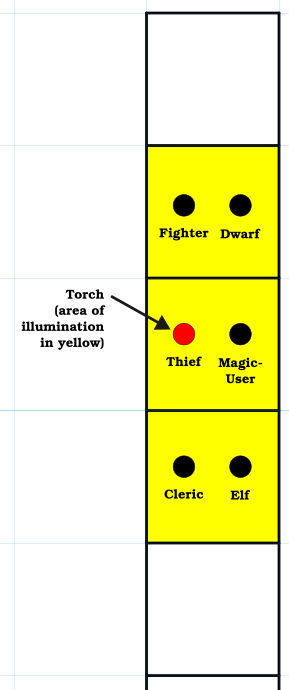 | 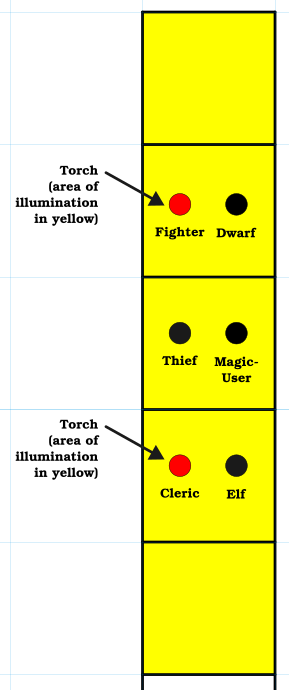 |
| In the leftmost example above a Thief and Magic-User are in the middle where they are somewhat protected. The Thief bears a torch, or it could be a lantern, so that the Fighter, Dwarf, and Cleric may carry shields. This provides a 30’ illumination, potentially up to 3 x 3 squares with the light in the middle. Taking up the rear are a Cleric and Elf. Let us assume the Elf is the group’s archer and therefore does not carry a shield. The one source of illumination covers only the Party and the demi-human’s infravision is spoiled by the light. | In the example at right above the Characters at the front and rear of the Party carry torches which means the torch-bearer gives up their shield. This however illuminates an additional square to the North or South because the 30’ centre of illumination, 3 x 3 squares, are the squares occupied by the characters carrying the torches. The dual source of illumination reveals a bit more of the underworld and again demi-human infravision is spoiled by the light. |
Note: If you have less than six players for such an order of march you may allow players to play an additional character or proceed in single file with the characters they have. Alternatively, you may allow the Party to hire on additional non-player characters to increase Party numbers but do not allow these characters to suffer mistreatment and be used like fodder! You will be role-playing them and they will seek to preserve their lives and, like monsters, will be subject to morale checks.
Where characters are in the marching order, and the available illumination, often restricts what they can see and do. For example were the Party to consist only of demi-humans with infravision they could see up to 60’. A character at the back of the party cannot melee with a monster located at the front.
Framing the Turns
Moderating what the players do means that their stated intentions must be broken up into turns and portions of turns. A turn is 10 minutes but it is really a reckoning of how much a character can do rather than a true measure of time. You will often need to judge what portion of a turn something takes to accomplish. The rules provide very basic guidelines, in one turn:
- A character may move. We shall assume our encumbered characters can move at least 60’ down the stairs in a turn and this includes mapping. A character may map an area equal to their movement. According to the text of the rules movement assumes that in the dark underworld the characters are mapping carefully, searching, and trying to be quiet. The character performing the mapping will have for at least some part of the turn the mapping materials in their hands; scroll, pen, and ink, not weapons, shields, or lights.
- A character may rest; they are required to rest for a full turn after every 5 turns or they suffer a combat penalty, refer to the subtopic RESTING, in Moldvay on page B19.
- A character may search a 10’ area.
- A character may fill a sack with treasure.
- A character may search for a trap.
- A Thief may remove a trap.
- etc.
As you listen to the players you will soon realize that a character will typically need to have their intended actions broken up into manageable pieces. While the framing regulates division what exactly can actually be accomplished is not specified, for example: should several characters each wish to try taking turns to listen at a door we are not told how long this activity takes and must decide for ourselves whether a full turn or a portion of a turn is required. The rules do not cite how long it takes to pick a lock so we have to imagine what part of a turn this might take to perform. The rules do not provide examples of what sub-portions of a turn, synonymous with minutes, are needed to accomplish various activities. Whatever we decide, let’s say we allow a full turn or some part of a turn, we will record so we rule consistently in future.
Rounds
Encounters and combat (aka melee) occur in 10 second rounds. I often refer to combat as “melee”. The use of the term melee appeared in the original D&D game, where I learned it, and there are references in those rules to the 2nd edition Chainmail rules. From the Moldvay rules onward we may infer that a “minute” consists of six rounds of melee, refer refer to the subtopic TIME IN ENCOUNTERS, in Moldvay page B23.
Note: The Moldvay and later rules the turn/round subdivision does not quite appear in the same form as in the original D&D game. In the original D&D game and Holmes a Combat-Turn is to be regarded separately from a Turn, and it is shorter. There are 10 rounds in a Combat-Turn in D&D. Holmes goes a bit further and specifies that each round is 10 seconds but still allocates 10 rounds to the Combat-Turn. The distinction we should make is that Moldvay asks us to not conflate the use of the term “Turn” in this way and disposes of the shorter Combat-Turn, refer to the subtopic TIME IN ENCOUNTERS, page B23.
In one Round:
- A character may attack a foe.
- A character may cast a spell.
- A character may move, their movement is divided by 3 for example, a character who moves at 60’/Turn moves at 20’/Round.
- etc.
Any activity which occurs in a Round must by necessity be brief and very simple. I would again encourage you the Ref to regard a Round as a division of activity rather than to look for “real-world” equivalents of what can be accomplished in 10 seconds. The game isn’t real.
Division of Activity
The understanding of the division of activity is essential going forward. It’s an important concept to master as it will help enormously. With regard to the foregoing I hope I have established that moderation involves seeing the conversation between the Ref and the Players in terms of the game’s contextual structure, it’s rules. After a while, once the rules are better understood, they will become second nature and invisible.
Lively Description
Let’s recall our example from the original game:
1974 REF: Steps down to the east.
Oh my, well this is hardly inspiring stuff but back-in-the-day, well, yes that’s the kind of thing that was said. I supposed we got used to it and didn’t think about it. As the leader of the game much depends on your presentation and you will have to evaluate for yourself whether your group is interested in more elaborate description. Everything the players will react to, in their character roles, depends on what and how you describe what is before them. In a manner of speaking you are their senses, eyes, ears, etc. They will interpret what you say. For example I might describe the following differently:
1974 REF: Steps down to the east.
2026 Ref: In your flickering torchlight you see that before you is a set of rough stone stairs, hewn from the rock; descending into darkness. They are crudely made, hardly even, and they are worn in the middle from the tread of many feet passing up and down them for a hundred years or more. Water drips from the ceiling, pooling where it collects, then trickling downward. It smells and feels of damp. A foul wind rises from below. You hear only your own footsteps, rustling movements, the clink of metal, and the burning of the torch flame as it flickers. All these seem un-naturally loud though you are being quiet.
Every description need not be so detailed but certainly you want to give attention to what you think is important. The idea is to initially create atmosphere, which once presented, the players then carry the idea of what it is like with them wherever they go in the underworld.
Practice what you say, read your prepared text aloud to start with and then re-read it placing emphasis on certain words or sentences to see how that sounds to you. The value of preparing beforehand is that you get to work out what it is you want to say and you can improvise on it. Players will soon learn to hang on your words if you emphasize elements of sentences, speaking softly or louder, faster, slower, giving strength to some words and less to others. It is in effect, dramatic reading. You will soon figure out what works for you and your players.
No matter what, I think just starting out is important. You have to begin somewhere so don’t be intimidated. That’s why we prepared beforehand. You can’t possibly know everything, and will have to refer to the rules from time to time. The players will very quickly accept you in your role as the Ref and leader of the game.
The Order of Events In a Turn
Starting out you will not have a complete understanding of the rules and nor should you expect to. That comes with time. At the very least as a part of your pre-game preparation you should read the examples of play and then try out the steps in the Order of Events so you understand how it is supposed to go.
Note: The topic, The Encounter, begins in Moldvay on page B23, and Mentzer’s Players Manual and Dungeon Master’s Manual discusses “the Turn” in considerable detail, in particular refer to the latter in the topic Running the Game on page 3. In consulting either of these books you can’t really go wrong. I offer guidance, from my own perspective, but you are leading the game, make it yours.
Let’s say we are ready, the players have their character sheets in front of them, snacks and beverages. We have a set of dice for the players, pencils, erasers, and notepad. We have an agreed upon order of march written down. They nominate one among them as the Caller for this game session. We’ll begin in a somewhat casual manner. Allow for the unexpected and whimsy.
Turn 1 – An Informal Beginning
Let’s begin the game at the entrance to our own underworld. Our first order of business is to start the first turn. We refer to Map Key 1 of our underworld we have prepared, and we can read the text to the players or summarize it in our own words:
Ref: Before we begin, just a reminder, your character’s must rest for one turn after every five turns. If you don’t rest there are penalties to your melee dice rolls.
Ref: Dawn finds you at the site of an ancient ruin on a high barren hilltop. Large moss covered fallen stones reveal that there once was a building here. All that remains now is an outline where its proud walls once stood. Within the jumbled stones a weather-worn wood trap door, perhaps once an entrance to a cellar, lies broken and open revealing an entry into the ground. When you look closer you can see that a tunnel slopes downward; daylight shines into the first 30’ of the tunnel before shadows and the dark conceal whatever it is that lies beyond. It doesn’t smell very nice, dank, and something else you do not recognize.
Ref: A mere few steps from the entrance there is a cairn of stones. Cairns as you know are stones piled over items to protect them from animals.
At this point the players talk over-the-game and decide what to do, they will then tell the Caller. It would be great, starting out, if at first the players do more than play themselves. Give it time!
What’s a cairn again?
A pile of rocks with something under it.
Oh, well I think we should search that.
Who’s going to look?
The Thief, check it for traps first!
Caller: Ok Ref, our Thief will check the cairn for traps and if there aren’t any we’ll take it apart to see what’s in it.
At this we, the Ref, begin to interpret what is required. Per the rules it will take the Thief one turn to check for traps. We ask the player to consult their character sheet and tell us what their chance of finding a trap is. At third level we have amended the rules and previously decided that a Thief begins with a base 20% chance at 1st level and rises 5% for levels 2, and 3, which makes the basic chance at level 3, 30%.
Note: Heyou Halt’s charcter sheet has the exact rules recorded from Labyrinth Lord; you will need to modify if you wish to follow my house rule.
You can allow the player to make this roll using d100. They will instantly know if they fail the roll and should that happen they won’t be sure if there is a trap present or not. There is some value in this because then it’s taking a known risk. If the dice roll is successful you must reveal whether there is a trap present or not. Revealing a trap is present is not at all the same thing as removing it; that is a separate roll, also 30%. Let’s assume the player’s roll for their character is successful:
Player: Rolls 2d10, 29, that was close!
Ref: You discover nothing harmful is present.
Caller: Good! We’ll gather around the cairn and dismantle it.
Ref: You begin to pull the rocks away by hand and it isn’t very long before you find there is an old leather backpack inside the cairn.
Caller: Excellent! I, Hamfist the Mighty, will Open it!
Ref: Inside is a length of Elvish rope, a lantern, and a couple of pieces of folded parchment.
The players, over-the-game, then discuss what is to be done with what they have found. They check among themselves which character’s can read. Their Magic-User has the best INT score and resulting abilities.
Caller: The Thief will carry the rope and the Dwarf the lantern. Our Magic-User is the most literate, and will open the folded parchments to see what is written there.
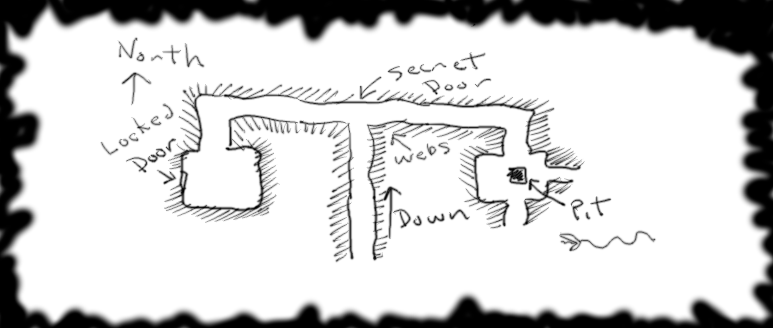
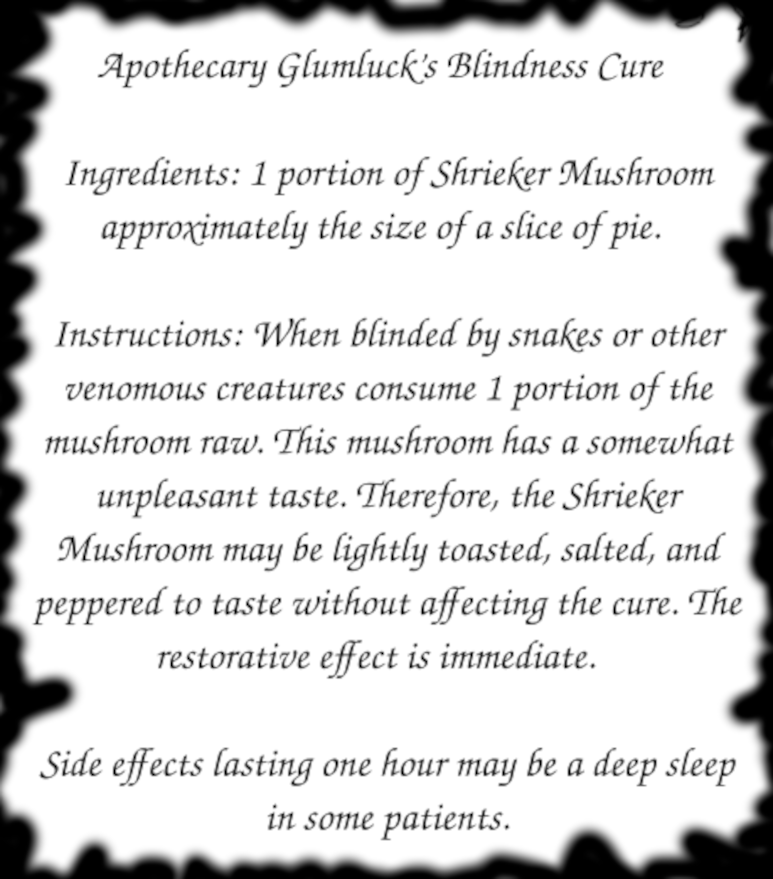
Ref: One of the folded parchment’s has a bit of map drawn on it. The other is a recipe.
[If they wish the Ref may make props before the game, two pieces of paper, or simply use a notepad. The following are examples of props. Note that we are under no obligation to be truthful, in fact the map isn’t accurate but we do provide a hint about the snakes in the pit.]
The players lean over the playing area to look at the two pieces of paper, and then pass them around. Discussion ensues:
Hamfist: So, if we go down the sloping passage there’s a secret door right in front of us. Huh. The tunnel goes East and West, and look, there’s a couple of rooms, the Western room has doors, and is that a trap door I see? I say we go down the stairs and West to the doors.
Heyou: We’ll have to be on our guard, there’s a secret door. There could be anything behind it.
Gruff: I says we open that first.
Astra: At the very least we need to check it and maybe keep an eye on it.
Heyou: I agree with Gruff, that secret door is not something to skip.
Tertius: I think the compromise here is to look for and open it and if we can’t open it then decide.
Rowan: We’ll just have to watch our backs to make sure nothing comes out without our being aware of it if we go West.
Burly: If we can’t open it, I say we just keep going. I want to find treasure! But if it does open I say we go through, there’s got to be something there or there wouldn’t be a secret door!
Caller: This parchment interests us since it is a cure for blindness but what exactly is a Shrieker Mushroom? Everybody looks at you the Ref but you don’t answer right away as you think it over. The player character’s will have no idea what a Shrieker is because it is not common knowledge; they will have to find out for themselves.
Ref: Unfortunately none of your characters know what a Shrieker Mushroom is or what it looks like.
We’ll say that this punctuates the first turn because what the players do next needs to be divided into its own turn. Nobody asked about the Elvish rope but I’m sure you’re dying of curiosity. Make something up if you want to give it unique properties.
“And they added also coils of rope, three to each boat. Slender they looked, but strong, silken to the touch, grey of hue like the elven-cloaks.” —J.R.R. Tolkien, The Fellowship of the Ring, “Farewell to Lórien”
Note: Of course we are heavily influenced by Tolkien’s strong elvish rope, made of Hithlain, the inner bark of the Mallorn tree, whose knots come undone by the will and with a tug from the holder as they did for Sam. Such rope is light and grey, with a silky feel. Of course our imaginary world is not Middle Earth but our own and we may decide if “Elvish Rope” in our own imaginary world has any interesting properties. Is it similar to the magic item Rope of Climbing as found in Moldvay on page B50? You decide. If you do, record your decision for later reference. Giving the player characters a magic item of this kind would be rather harmless yet helpful.
Turn 2 – Wandering Monster Check
The Order of Events in a Game Turn appears in Moldvay on page B53 and in Mentzer’s Dungeon Master’s Rulebook on page 3.
One of the first things we want to know as a Ref is how often we need to check for a Wandering Monster. This check appears first in the order of events in a turn but the text later places it at the end of a turn. Are we confused? Yeah. Follow the order of play, per Moldvay or Mentzer and do it at the beginning.
As the players explore the underworld, or a wilderness, the Ref makes a secret 1d6 roll of chance to determine if Wandering Monsters appear.
Note: With regard to the frequency of this check roll the various iterations of the rules will tell you different things. In the original Arneson/Gygax game it was at the end of every turn, which really meant every two moves; this is not quite the definition of a “Turn” we are used to. Holmes modifies this and we are told on page 10 of the topic Surprise to check for Wandering Monsters every three turns; which I interpret to mean every 6 moves. The definition of a Turn changes from Moldvay forward. On page B53 Moldvay says at the end of every two turns. Mentzer concurs and says every two turns, refer to the Dungeon Master’s Rulebook on page 3.
I have some comments about the frequency of this check. As the Ref you have the agency to alter the frequency of the check. You can’t really go wrong if you check every two or three turns. However, you may decide this is far too often and decide to check at less frequent intervals but I would be sure to make one at least once every 5-10 turns. I would therefore recommend that you customize not only the frequency of this check on a per-level/region basis, but the wandering monster tables you use for it.
There is another matter, as we are playing our first ever game it would probably be a good idea to down-play this check on the doorstep of the underworld. We’ll pass over it this time and check in five turns at which point we’ll cover this check-roll in greater detail.
| Turn | Reckoning |
| 5 | Check for a Wandering Monster |
Turn 2 – Ref Guidance
We need to read the descriptions of not only Map Key 2 but the surrounding Map Keys, 22, 20, and 7. Nothing exists in isolation. We learn that the Kobolds on guard in Map Key 22 will, on seeing light at Map Key 2 on turn 2, leave to warn their leader Bark of intruders. When this condition is satisfied in three turns they will have reached their leader at Map Key 17.
We have suggested in a previous article that the Kobolds will attempt to attack the Party from two directions:
The Kobolds at Map Key 22 move to Map Key 17 and inform Bark (allow one turn for the Kobolds to deliver the message and for Bark to issue instructions) who then divides the pack into two with Bark in the first group, 8 in each group, first group moving through 17 through 20, to 2, and the second group moving from 17 through 19, through 22, to 2. The idea is to ambush the Player Characters from two directions at or near Map Key 2. The Kobolds know all about the secret door at Map Key 2. Because Kobolds move 60’ per turn it will take the first group three turns to reach Map Key 2 so the second group will move to Map Key 20 and wait one turn before moving to Map Key 2. This will allow the entire pack to attack at the same time. It also means that the players will only have seven turns to explore before being ambushed.
If we follow this guidance it means that we can expect the Kobolds to arrive in four turns, after completing movement on turn 6. Remember it’s a suggestion, not a directive, and if the Kobolds arrive a turn or two later there’s no issue. The “timeline” as it stands gives the Party the opportunity to start their exploration.
| Turn | Reckoning |
| 5 | Kobolds reach Bark at Map Key 17 |
| 9 | Torch extinguishes, Kobolds Arrive at Map Key 2 |
Turn 2 – Marching Order
Remember that moving includes searching, mapping, and moving quietly. The overall composition of player character activities is variable. Short of encountering a monster, which is covered by step 3 of the order of play, the Party can actually do rather more than what is listed and this should be expected.
Most of the time you will not need to closely monitor the progress of the turns except to keep an eye on when lights extinguish. In this case though, as an example, we have several things going on, notably the upcoming Kobold ambush so we want to know who in the Party is doing what and when the Kobolds arrive. We must remain aware of how best to divide activity within the turns.
Caller: Very well, the Magic-User will put the parchments inside the cover of his spell book – if you have no objection. [Astra nods.] Then we’ll form our marching order, Heyou will light a torch, and we’ll descend the sloping passageway into the underworld.
As the Ref you make note of when the torch was lit. We have to count down to when it extinguishes. A torch will only last 6 turns before it extinguishes. A lantern’s illumination will last 24 turns before it runs out of oil.
Astra: What about the bit of map?
Hamfist: I suggest we make our own as we go and refer to the parchment as we need to?
Ref: The passage is dark and you can feel the slope under your feet. It is damp in here, you advance some 50’ and discover that cobwebs hang at the end of the tunnel, there is an opening here but you can’t see more.
Gruff: I’ll have to light a lamp or torch. I’ll put away my shield and light this lantern we found, assuming it’s full.
We’ll say that the lantern is full of oil otherwise it isn’t much of a gift. We make note of when it was lit. We have to count down to when it extinguishes.
Caller: Ok, with the lantern lit can we see anything beyond the cobwebs?
Ref: There is a passageway leading West and East.
Caller: My character, Hamfist, will cut down the cobwebs with a sword. We’ll advance the last 10’ of our movement this turn into the passageway in front of where we think the secret door is.
Caller: Let’s see about this secret door, we’ll search for it.
Ref: Who is searching?
Caller: first my character, Hamfist, and then Gruff Stonebeard.
This means you need to implement a rule. On the character sheets each has an x-in-6 chance of finding doors. Hamfist has a 1-in-6 chance but Gruff has a 2-in-6. This activity we have already learned will take 1 turn. As the marching order allows 2 players per square they can each make this search in the same turn. You, the Ref, may roll secretly for these check-rolls if you wish, many do. However, I allow the players to make this roll. If they fail, they will still be in doubt as to whether there is a secret door present. Players enjoy rolling the dice and taking their chances. Hamfist’s player publicly rolls 1d6, the result is 6, fail. Gruff’s player publicly rolls 1d6, the result is 2, success!
Ref: You, Hamfist find nothing, all you see is a damp stone wall, Gruff however finds the secret door—
Caller: Aha! So the parchment map is right!
Some Refs allow that the finding of a secret door also means that the means of opening it is also discovered at the same time, not me, but you may do as you wish. I allow that if the players do not discover the means of opening a secret door they can force it as if it were a stuck door.
Note: The players might, thinking it is a shortcut, decide to start searching for switches instead of secret doors, in which case I would make this search more difficult, substitute a d8 for the d6, making the chance of the discovery of the secret door and switch 1-in-8 or 2-in-8 allowing for the character class.
Ref: The problem is, how to open it…
Caller: Gruff and I (Hamfist) will search for a hidden button or lever!
This second search of a 10’ area the Ref will decide must take place in the following turn. We can consider whether the rest of the Party wishes to take individual action in this turn.
Ref: Is there anything else other characters of the Party want to do?
The players then discuss over-the-game what actions the others might take.
Caller: As we search Heyou will watch the Western passage while Astra will watch the Eastern passage.
These characters are each looking around the corners of the passage. It’s dark, an additional square on either side of the one facing Map Key 2 is illuminated, but they don’t see anything in those squares.
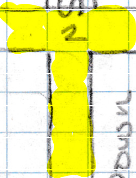
Ref: The lantern lights up the passageway to either side of you, casting shadows, but nothing is there.
Turn 3 – Searching for the Switch
In our underworld text for this Map Key we have allowed a 3-in-6 chance of spotting the worn stone switch which opens the door. This sort of roll is often made secretly but we will allow the players to make it. A successful dice roll creates certainty. There is either something to find, or not. Even when a player fails their dice roll they then can’t be sure whether or not there was something to be found. They roll 1d6 each for Hamfist and Gruff. They roll, 4 (fail) and 3 (success).
Ref: Beside the door Gruff spots a worn bit of stone which looks like it has been pressed in many times.
Caller: That’s it! We press it.
Ref: When you press the stone you hear something mechanical moving within the wall and the door swings open inward ever so slightly.
Caller: Excellent! We’ll push the door open.
Ref: As you do so it pushes a wooden box aside, which scrapes across the floor. Inside you see a short passage beyond which there is a larger opening but your light doesn’t show you more.
Caller: So, it appears this opens into a room.
Ref: Yes.
Caller: Is the box empty?
Ref: It appears so.
Talking over-the-game the players decide to ignore the box. One wants to search it but the others believe that because it moved aside when the door opened it is empty.
Caller: We’ll move forward, North, until we enter the middle of the room.
Ref: You move ahead 30’ to the middle of the room.
The Kobolds previously left Map Key 22 on turn 2 and are no longer in the room. The area highlighted below is illuminated.
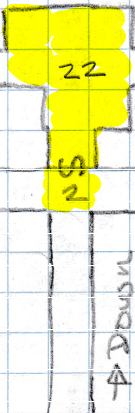
Turn 4 – Entering Map Key 22
As the Party advance to the middle of the room their lights illuminate the whole of Map Key 22. When you use theatre-of-the-mind you may describe the room as required. To map the room on graph paper though, such that the players can draw it, requires time consuming description and practice. You may want to draw the room. The players have the map they found in the cairn to start off with and they can add to it. I have a player put their pencil on a particular point and tell them how far to draw a line and in what direction, North, South, West, or East, etc., until the area revealed only by illumination is drawn.
Ref: Your light reveals that you are in a room, oddly shaped, which has open exits to the West and East. There are wooden boxes stacked here, upon which grow mushrooms.
Caller: We’ll search the boxes.
Ref: They are not in very good condition, mushrooms, fungi, grow on them, and they are empty.
The Party have, in their excitement to find treasure have forgotten to guard the exits to this room. It is entirely possible you will have to hint and otherwise encourage the players at times.
Ref: The passageways to the West and East are both dark, it feels though like something is watching you. Your skin crawls. The place is eerily quiet. A few drops of water from the ceiling land on the floor, plink, plink, plink, plop—
We just made this up! This kind of thing makes the players wary, but reveals nothing, and as you can see, there isn’t any certainty in this presentation, only the creation of a feeling that our underworld is a place of danger. Your descriptions, if they evoke an emotion, make the game more vivid.
The players look at each other. We should be watching! They quickly divide to watch the exits.
Caller: Hamfist and Gruff will take the Western exit, Rowan and Lumina the East, Heyou and Astra the secret door, and we’ll stop and listen for monsters.
Each character has a different chance of hearing noise. There are no monsters in Map Key 4 and 19 to hear but somewhere to the west and three turns, 180’ away, are our Kobolds. The question is, can they be heard? Is there something to hear? Hamfist has a 1-in-6 chance of hearing noise. Gruff has a 2-in-6 chance. Most Refs will make these check-rolls but you may allow the players to make these rolls. A successful dice roll creates certainty. There is either something to hear, or not. Even when a player fails their dice roll they then can’t be sure whether or not there was something to be heard. The players roll the dice, 6 and 6. The players know they fail. Nevertheless you can still say something aesthetically pleasing.
Ref: You hear only the plink, plink, plink, plop of water dripping from the ceiling as it strikes the floor.
To the East, beyond Map Key 4, in Map Key 5, are monsters, Giant Shrews. Can the player character’s hear them? Rowan has a 2-in-6 chance of hearing noise. Lumina has a 1-in-6 chance. The players roll the dice, 2 and 5, Rowan succeeds, Lumina fails. This will mean the Party can no longer be surprised by the Giant Shrews.
Ref: You hear the plink, plop, plink, plop, of water dripping from the ceiling as it strikes the floor and something moving in the distance, followed by a faint squeak.
This does not mean that the monsters discover the presence of the player characters. Giant Shrews are blind, so they will not detect the player characters lights. If the player characters are moving and exploring normally and quietly the Giant Shrews will not hear them.
Listening at the open secret door are Heyou and Astra. Heyou has the best chance of hearing noise, 3-in-6. Astra has a 2-in-6 chance. The players roll the dice, 3 and 4. Heyou succeeds, Astra fails. As the Kobolds wish to ambush intruders it isn’t in their best interest to give themselves away. We decide they are being quiet and though they are 180’ away any noise they make is not perceptible.
Ref: You hear only the plop, plop, plink, plink, of water dripping from the ceiling as it strikes the floor.
Note: I have improvised the sound of the water drops, all different. Some players will try to figure out if that has meaning. I didn’t assign meaning but you could, I leave it to your ingenuity.
Note: Did the Kobolds, in their hurry, leave any recent and obvious wet tracks leading west on the floor? If the player’s search for such you can improvise whether they are present or not and if you will require an x-in-6 or INT Ability check-roll to spot the tracks. Be careful, we are improvising a classless check-roll for this circumstance only and not intentionally creating a repeatable class ability.
The marching order has been broken up, so you may want to make note of where the player characters are.
Turn 5 – Wandering Monster Check Roll
Per our previous decision regarding the order of play, we will now make a secret check-roll for a wandering monster. We will conceal this dice roll and its result from the players. There is a 1-in-6 chance of a wandering monster. Roll 1d6, a result of “1” indicates that wandering monsters appear, refer to page 48 of Mentzer, or B53 Moldvay.
Note: You can make this spicier by changing it to 2-in-6 particularly if the Party have been very noisy, hammering, battering, mining, etc. Perhaps you decide the result of a particularly noisy combat, blowing of horns, raises the chance of the following wandering monster encounter to 3-in-6.
We decide the Party has acted normally so we roll 1d6, the result is 3, no wandering monster appears this turn. We’ll check again on turn 10.
| Turn | Reckoning |
| 10 | Check for a Wandering Monster |
Turn 5
Unknown to the player characters the Kobold sentries formerly posted at Map Key 2 arrive at Map Key 17 to alert their leader, Bark. They tell Bark about the light and the number of player characters. Bark takes one turn to give orders to his band. On turn 7 the Kobolds will set out for Map Key 2 in two directions to ambush the Party, front and rear.
The players discuss over-the-game the noise they heard to the East and come to the conclusion there is a monster in that direction. What sort of monster is most likely to have treasure they wonder among themselves. They decided to investigate.
Caller: We reform the marching order and move to the Eastern opening.
The illuminated area changes depending on where the characters (indicated by the red dots) are positioned. In the illustration below the area of illumination is highlighted; those areas not illuminated are dark. This is not something you need to do but it is useful to understand the limits of illumination.
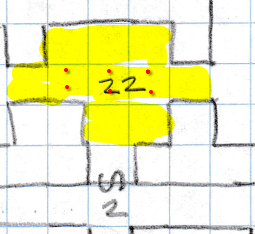
Ref: In front of you to the east is a short passage which looks like it opens into a room.
We have previously read the text of Map Keys 4 and 5 and we know that Map Key 4 has stalactites formed on the ceiling, water drips onto the floor. The Eastern exit to Map Key 5 is partially blocked by a large stalagmite. This is not visible yet as it is not illuminated by the lights carried by the player characters at the front and end of the Party. The Giant Shrews are blind so they will not see the lights carried by the player characters. These monsters have left tracks on the floor which the player characters may spot if they search the room.
Caller: We’ll advance 20’ into the room. Lumina and Rowan will keep watch at the rear.
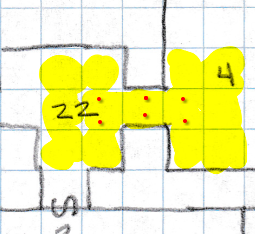
Ref: Your lights do not illuminate the entire room. Water drips from stalactites on the ceiling an plops onto the floor.
Caller: We’ll advance 10’ more into the room.
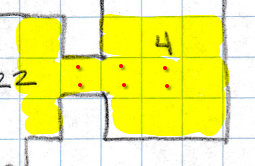
Ref: Your lights still do not illuminate the entire room, there is more to the North, but you can now see the Southern part of the room.
The players, talking over-the-game, decide that Astra and Heyou will search the Southern area of the room while Hamfist and Gruff stand guard against possible dangers from the North.
Caller: Gruff and I (Hamfist) are listening for more squeaks. Astra and Heyou will quietly search the South of the room, and the others will watch our rear.
When players are searching for a secret door they have a specific purpose known to them but in this case the presence of information which might be revealed through the act of searching is unknown and secret. If the check roll fails we do not want to reveal the presence of the secret. Therefore the Ref will make a hidden x-in-6 roll for each of the searching players and not reveal anything if the rolls fail.
Note: Players usually figure out that once the Ref starts making secret rolls something is happening but this is over-the-game information their characters are not party to. A certain amount of player apprehension is unavoidable. Please avoid making sinister laughs and looking like you enjoy making secret rolls!
It’s useful to empower the player characters and allow them to do things. Per our text, we have previously decided that searching players have a 1-in-6 opportunity to spot the Giant Shrew tracks on the floor. They can then, once the secret information is revealed, choose to attempt to follow the tracks, which lead North to the Eastern exit; a successful d20 INT attribute check-roll is required. A player must roll less than or equal to their INT ability to succeed.
To first spot the tracks during the search the Ref makes separate d6 rolls for Astra and Heyou, the result is 5, and 2. Astra doesn’t spot the tracks but Heyou does.
Ref: Heyou and Astra search the Southern part of the room. It’s damp, Heyou looks at the floor and suddenly spots there are tracks there, they look like rat tracks, only much larger.
Heyou: Look at that! Tracks! What made them?
Ref: You don’t know. They are clawed—
Had the character encountered Giant Shrews previously I would allow an INT ability check roll to identity the creature which created the claw marks.
Heyou: Can I tell which way they go? Can we follow them?
Ref: Make an INT attribute check-roll with a d20, if you roll less than or equal to your INT your character can figure out where they go and follow them. Please understand that this roll applies only to this particular situation.
Heyou’s player then rolls d20, the character has an INT of 12 and so must roll 12 or less, 10, success!
Ref: The tracks lead north, into the stygian darkness…
We’ll leave off here and in the next article we’ll continue our turn 5 game-play.
Resting
Coming up on turn 6, per the rules in Moldvay, refer to the topic RESTING on page B19; or in the OSE Classic Fantasy Rules Tome refer to the topic Resting, page 119. The Party is required to rest for one turn in every hour or they will have a penalty of -1 on all melee attack and damage rolls until they do rest. Our new players will need to be reminded to rest.
Note: There are actually several rules regarding resting in the underworld and wilderness. In my experience practically every Ref, myself included, either glossed over or ignored the rest requirements at times in favour of seamless continuation of the action. If you enforce the rule, players may grumble but they’ll do it to avoid the melee penalties. It is a time when the Party can sit quietly and listen. If the rest period lands on a turn when you check for a wandering monster and an encounter is subsequently indicated the Party will not get the benefit of rest and incur the melee penalties. Therefore, consider resting a part of player risk management. If they ignore the rest period and press on that is a risk taken.
| Turn | Reckoning |
| 6 | Party is required to rest for 1 turn or -1 melee and damage roll modifier until they do rest. |
Ref: Just a reminder, your character’s are getting tired and should rest for one turn, next turn. If you don’t rest there are penalties to melee dice rolls.
In the Following Articles
I hope my examples of how I would begin to lead the game have proven useful thus far. I hope you’ll indulge me where I deviate slightly from the examples given in the rules. Mentzer, for example, simply cannot be beaten for examples of play but my experience leads me to emphasize certain things in my own presentation.
Of course our players could, within the scope of a Turn, be quite busy with each of their characters searching etc.
In the following articles we’ll continue with the example of our player’s underworld adventures and our intention is to present the order of play in a manner that it might occur. Ahead of the Party somewhere in the stygian dark are dangerous Giant Shrews which it seems they are sure to encounter before the Kobolds arrive. What will happen?