The Old School Dungeon – Populating Level 2, Theatre of the Mind
The Underworld as Theme
With Level 1 populated with monsters, treasure, tricks, and traps we can remind ourselves that we need no wilderness to start with, no grand vision for a wilderness campaign is required. The “story” is the adventure the players make with their characters as they explore this strange and dangerous underworld. Their adventure is improvised against the background of the underworld you the Ref have prepared. If we follow the recommendation of Gygax and Arneson in Volume Two of The Underworld and Wilderness Adventures, as affirmed by Holmes, Moldvay, and Mentzer, we should prepare at least three levels. This is particularly important if, as in our case, we have created entrances to the levels below in the form of stairs, sloping passages, shafts, and teleportals. It is worth repeating that you do not have to have more levels if you do not want them right away. Small dungeons with a single level can be sufficient for an evening’s entertainment.
I know I am citing old rules but what I am driving at is an essential part of the Dungeonmaster/Ref experience. If you look at Underworld and Wilderness Adventures you would find an example map and key but little else. You were expected to make your own underworlds and that is just what we did. Holmes Basic treats the subject of the underworld in the same manner as the original game. I often think of these rules as being closer to the original than later iterations. Jumping ahead in time Moldvay gives you an example of a 1st Level Dungeon. Leaping forward once more in Mentzer (BECMI) we find an example of a three level dungeon in which the third level is left for us to create. All of the Basic Sets from Holmes onward came with modules B1 or B2 which were pre-prepared adventures. These fleshed out the wilderness and underworld concept and are meant to inspire.
The Player Experience
Basic D&D; Holmes, Moldvay and Mentzer, were aimed at starting out Players at Level 1. Those rule books covered only the first three levels. We always started characters out at Level 1 and worked up from there and starting out at a higher level never occurred to us. I have found that payers will push their characters to the brink of destruction (and beyond) which will occur sooner than later in this game as Level 1 characters.
In the ol’ days not many characters made it to 3rd level. Attrition was high. There were no character sheets. We wrote everything down on sheets of loose leaf paper. Combat can be pretty deadly and if your character begins the game with 6 Hit Points or less you could be quite easily taken out of the game in the first successful monster attack. I threw out lots of characters.
Note – It was only much later that I realized the math of the combat tables doesn’t really favour the characters who have a 55% chance of striking an AC 9 Monster at 1st to 3rd level. This does not change whereas monsters slowly creep upward at 5% per hit dice per hit dice, so their chance of a successful attack vs. AC 9 is 55% at their 1st Hit Die, 60% at the 2nd Hit Die, to 65% at the 3rd Hit Die. What this means is that monsters are more likely to hit and cause damage than the player characters.
What we are really talking about is the quality of the “player experience” and if we spend at least a half an hour or more with a new player rolling up a character and equipping them only to have them out of the game in the first five minutes or less of combat that is a very dissatisfying experience which could well result in a player almost immediately losing interest. What are we, as the Ref, to do?
There are some house rules from the old days attributed to Gary Gygax in which it was advised to start player characters out at Level 3 rather than Level 1. This means that the player characters have better saving throws and more hit points. This theoretically translates into a “better” game experience.
I can see the point of the house rule as it would contribute to character longevity in an introductory game. Given what I have observed as both a player and a Ref is that we have a tendency to push things to their limits. Increasing Hit Points and improving Saving Throws does have the effect of delaying the inevitable. I would house-rule this further:
- All characters begin at Level 3 but with zero XP, which means they must work up to Level 4 from 0 XP.
- The character’s first hit die always has the maximum HP, roll for the remainder.
The Gygax House Rules are intended for use with the three books of the original game without the supplements. There is an important distinction to be made, all characters in those rules used d6 for their Hit Die. In later Basic rules, character Hit Dice differentiated from the d6 that was used in the original game by all characters and this made it a lot harder to play the game as a Magic-User. Personally, I think the d4 is too small and contributes to the player experience in a negative way. I know this will be a heresy where a lot of people are concerned but I would house-rule and modify the Hit Dice type for this character and that of the Thief as part of our mastery of the rules:
- Magic-Users and Thieves will now use a 6 sided die for hit points.
If you want to stick to the canon of the rules, by all means do so. Even with these additions players will find that descending to Level 3 of our underworld will not be a pushover.
Theatre-of-the-Mind
What is Theatre-of-the-mind? The underworld, and wilderness setting, are imagined by the players without physical aids such as miniatures. You might not have a play mat, miniatures, and all the accessories and dew-dads which pinpoint the location of characters and monsters down to the last inch. Those things can be helpful but they aren’t strictly necessary even though the underworld adventure is descended from a game of battles fought by miniature armies.
Simple descriptions will evoke more of the shared experience in the mind of the players than any toys ever can. A scratch pad and pencil can be used in lieu of physical aids to write down the marching order, who goes where, and to depict the shape of rooms. Physical aids will never convey the experience of the senses and that is where you as the Ref come in. The players cannot know what things are like unless you tell them. They won’t hear the plop of water dripping from the ceiling, smell the dank air, feel wind in the underworld, or hear the scratching of terrible unknown things in the dark unless you tell them about it. What you say and how you say it, with a little dramatic elocution, makes the game come alive in the imagination. We’ll try and make sure our descriptions stoke the imagination of the players.
Mapping
The players will not see your dungeon map and that is why I do not recommend spending time making them pretty. The maps only have to be functional. I have thrown out more underworld maps than I ever kept.
Often, the players will want to try and draw a map of the underworld on graph paper as they go along in order to better understand where they are. I refer you to Moldvay page B19, B60, and Mentzer Basic (BECMI) pages 14, 53, and 56, Describing the floor plan of your underworld so that someone else can draw it can be a bit challenging and I have found that while the players could often render a map from description I often used to draw the portion of the map the characters were in to speed the game along without revealing anything more than their torches and lanterns might show at that time. The rules do not recommend this as habitual practice but I think it is unavoidable. The rules go so far as to recommend drawing an outline of the dungeon to give to the players but I think this gives too much away. I yield to practicality.
Designing Level 2
With Level 2 we repeat our methodology as learned previously. We’ll repeat the process we learned in creating Level 1, picking the treasures we want to place, then choosing some monsters, traps, and specials we like, and then randomly determine the remainder of the content for this level.
In the articles I sometimes refer to the Moldvay/Cook rules and in other places to the Mentzer (BECMI) rules. I bold the B in (BECMI) when I am referring to the basic books, E for Expert, etc. Mentzer splits the rules into Player and Dungeon Master books while Moldvay does not. I regard the rules in a wholistic fashion rather than rely on a single iteration. Due in part to my age and experience, I have an informed gestalt of what the game is about and what it means to me. There are a few differences between the various rules which may not be apparent without a deep dive. In the main though, they are quite interchangeable. If you are just starting out with clones like Labyrinth Lord or Old School Essentials you will be satisfied with either of them.
Let us proceed. Level 1 provided us with a couple of interesting Map Key descriptions and these are worth developing further into more interconnected themes for Level 2. Let’s start with the Acolytes of Pestilence because they are intriguing.
Review – The Acolytes of Pestilence
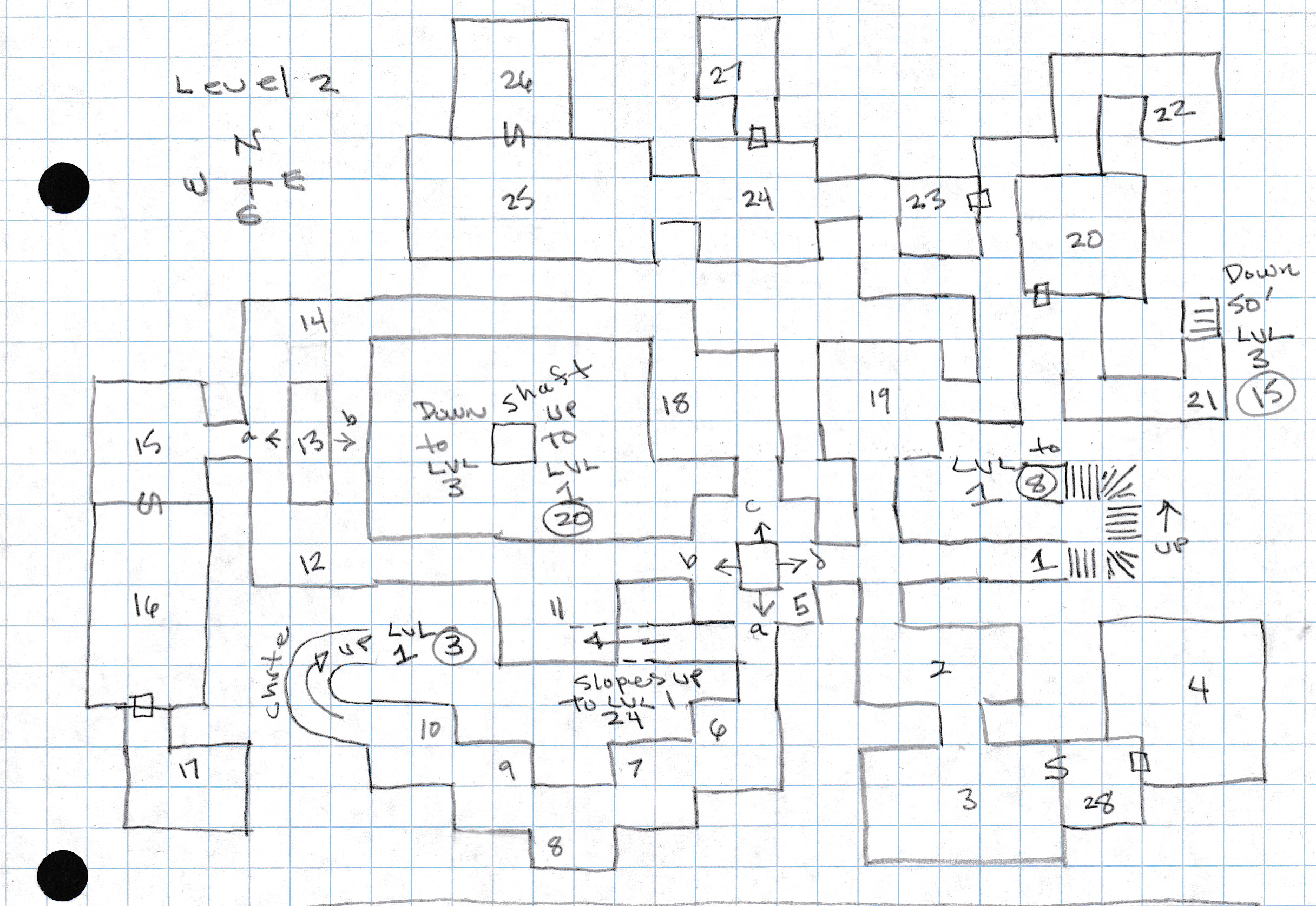
When we last saw Thrax our nefarious Chaotic Cleric and Acolytes at Map Key 8 of Level 1 they were in the middle of retrieving a coffin containing a plague ridden Zombie which we have already said they obtained from somewhere on Level 2. Where is that somewhere? What is it like? Are there more? We shall say that the coffin (and others) were stored at Map Key 26, which is a secret room.
Zombies, refer to their description in Moldvay page B44, Mentzer Dungeon Masters Rulebook (BECMI) page 39, Labyrinth Lord page 103, Old School Essentials Classic Fantasy Rules Tome page 215, we find are mindless undead created and commanded by 8th Level Clerics and 9th Level Magic-Users, and often used by them to protect treasure. Refer to Mentzer Expert (BECMI) pages 4 and 7, 10, 11 and 14 for the spells assigned by level and the spell descriptions.
Note – the spell Animate Dead appears as a 3rd level Cleric spell in Labyrinth Lord. It is not found in Moldvay Basic, or the Cook Expert fourth level Cleric spells on page X11. It does not appear as a Cleric spell in OSE on page 72. In most rules it is first-most a Magic-user spell which later makes a crossover to Clerics. Lawful Clerics are not supposed to create Skeletons and Zombies.
As they are commanded only by the character who creates them there is no way for the mere 2nd Level Adept of Pestilence to control this Zombie. It’s probably a good thing the plague bearing wretch is locked in the coffin. We shall propose it can’t get out of this “confinement.”
What goodies should this level have? We’ll select the following:
- +1 Magic Sword, +3 against Undead
- +1 Dagger
- Bag of Holding
- +1 Ring of Protection
- Scroll, 3 MU/Elf Spells
- Scroll Protection from Undead
- 3 Healing Potions
- Elven Boots
- 1000 silver coins
- 600 gold coins
What monsters should this level have? This time we’ll choose the following from the Mentzer (BECMI) Wandering Monster table for Level 2:
- Carrion Crawler
- Ghouls
- Oil Beetles
- Skeletons
- Stirges
- Zombies
Map key 1
1. Bottom of the Stair. The stair from Level 1 Map Key 8 ends here.
Secret Ref Info: There is a trap here, a murder step at the bottom of the stair, which is of a different height and causes characters to trip and fall 3-in-6 of the time if they do not spot it, 1-in-6. Falling causes no damage the character merely falls prone at the bottom of the stair.
Note – It may be implied from the rules of melee that a fallen character forfeits a round of combat in order to stand, would lose any defensive bonus for dexterity or shield and the attacker gains +2 to their attack.
Map key 2
We will skip over this key and randomly determine its contents later.
Map key 3
We will skip over this key and randomly determine its contents later.
Map key 4
We have previously created text which we will insert here and modify.
This raises a question, how many Ghouls are meant to appear on any given Level? Ghouls are a 2 Hit Die Monster and as such they normally appear on Level 2 of an underworld. The Number Appearing is modified when they are found on levels below 2, or levels above 2. The following is from Moldvay page B30.
When the same monster is met on levels greater than the monster’s level, more monsters should be encountered or when encountered on levels less than the monster’s level, fewer monsters should be found.
This text is perfect. The rule is confirmed by Mentzer’s text but I am not fond of the wording due to the use of the words upper and lower as their meaning might be misconstrued, refer to the Mentzer Basic Dungeon Masters Rulebook (BECMI) page 22:
If a monster is encountered on an upper (easier) level of the dungeon, the number encountered should be less than the number given. If a monster is encountered on a lower dungeon level than its Hit Dice, the number appearing should be more than the number given.
Moldvay and Mentzer then proceed to disagree on the number of Ghouls appearing on Level 2, 1-6 vs. 1-4 in their wandering monster tables. Despite these default allocations it is intended that the Dungeon Master/Ref use their own judgment to decide how many monsters are finally placed. When we look back and refer to page 11 and 12 of The Underworld and Wilderness Adventures we find the conduct of the game did not rest in mere rigid textual canon.
If the level beneath the surface roughly corresponds with the level of the monster then the number of monsters will be based on a single creature, modified by type (that is, Orcs and the like will be in groups) and the number of adventurers in the party. A party of from 1–3 would draw the basic number of monsters, 4–6 would bring about twice as many, and so on. The referee is advised to exercise his discretion in regard to exact determinations, for the number of variables is too great to make a hard and fast rule.
Holmes Basic is closer to the original Dungeons & Dragons and explains this concept quite succinctly, refer to page 10:
The number of wandering monsters appearing should be roughly equal to the strength of the party encountering them. First level adventurers encountering monsters typically found on the first level of a dungeon should be faced with roughly equal numbers, i.e. a party of three would encounter 2-6 orcs, 3 – 1 2 giant rats, etc. However, if the party were second level, or the first level monsters were encountered on the second level of the dungeon, the number of wandering monsters encountered should be doubled. In a like manner, the number of monsters should be tripled for third level adventures or in the third level of the dungeon if the monsters appearing are first level.
The above principle, as found in the original Dungeons & Dragons game, was in part made possible by both player and monsters using d6 for their hit die type. When variable hit dice were introduced this equivalency was lost. What would I do? It is not quite enough to summarize the total hit points of opposing parties. A comparison of the current total hit points obtained through the type of hit die cannot be the only factor as the chance of a successful attack is directly connected to the number of hit dice on the attack tables. First Level characters will, as I have pointed out previously, have a lesser chance of a successful hit vs. a second level monster on their attack table than the monsters do vs. the player characters on their attack table. This has to be a consideration for the Dungeon Master/Ref. Moreover, the original game used d6 for damage dice but the introduction of variable dice and multiple attacks also make it more difficult for the Dungeon Master/Ref to assess what should be the number appearing.
Also refer to Holmes Basic page 22:
In setting up his dungeon, the Dungeon Master should be guided by the table given under Wandering Monsters, so that the adventurers have a reasonable chance of survival. There is endless opportunity for inventiveness in the game, however, and if a high hit dice monster is desired, ways can be invented to scale it down so that a low level party can have a chance of defeating it.
Dungeon Master agency is baked in. As part of our mastery of the rules what the above means is that in keeping with the spirit of the game should the First Level player characters venture to level 2 or 3, you as the Ref, can reasonably adjust your content, improvising the number appearing and statistics of any monsters previously prepared in your underworld, to provide the player characters with the potential for a reasonable chance of survival. As the game is played you can to temper what you have written in the knowledge that if all the player characters are too quickly slain the game is over and this is never an enjoyable experience. At the same time the game should never be a walkover for the players and they should be able to determine when they are over-matched, assess what the risks are to their characters are, and moderate their actions accordingly.
What will we do? As we are discovering the rules aren’t quite identical from edition to edition. As the number appearing varies somewhat with the iteration of the rules we are using we will reduce the number we previously created to 1-4 per Mentzer (BECMI), so we’ll say there are 3 Ghouls because I already named them, they are like my pets now. Bonecracker, Nevertaste, and Bilebite. If this were a fun-house dungeon I would role-play them as if they were the Three Stooges… As we are being serious we decide the Ghouls are foul creatures of Chaos which have taken the magic sword to prevent it from being used against them. Still, they are loathe to touch it.
4. Ghoul Lair. 3 Ghouls, 4 if Chillyfist is present. The Ghouls are hunched over a corpse of a Giant Shrew which they are in the process of consuming with great relish. They have poor table manners. What table? They are eating off of the floor.
Secret Ref Info: There are 4 Ghouls, Armor Class 6, 2 Hit Dice, Chillyfist, (9 Hit Points) Bonecracker, (4 Hit Points) Nevertaste, (8 Hit Points), and Bilebite (8 Hit Points), Move 90/30, 2 Claws, 1 Bite 1-3, +Paralysis (2-8 Turns), Saving Throw F2, M9, Alignment Chaotic, description Moldvay page B35.
Scattered on the floor amid Ghoul dung, bones, and gristle, are 2000 Silver Pieces, 3000 Gold Pieces, and a +1 Magic Sword named Skullthrasher (it’s written on the blade), +3 against undead which the Ghouls have taken to prevent it from being used against them and they are loathe to touch it.
Remember that the player characters will have no idea what magic items are, refer to the topic Identifying Magic Items, Moldvay page B47, Mentzer (BECMI) Dungeon Masters Rulebook page 42, Labyrinth Lord page 107, OSE Classic Fantasy Rules Tome page 232. The Player Character must learn what an item is by trial an error or consult, and pay for, identification.
Map key 5
This room contains a blocking stone, which (refer to the map) moves randomly, to (a), (b), (c), or (d). Normally these sorts of things move randomly, so you would roll 1d4, a result of 1 means the stone moves to a, but we’ll put a twist on this and say this stone moves when it is approached. Lets say the stone moves 10 feet per melee round and it is triggered by the approach of a character within 60 feet. So when a Fighter is the first closest character to the stone it moves to (a), when a Cleric is the first closest character to the stone it moves to (b), When a Magic-User is the first closest character to the stone it moves to (c), When a Thief is the first closest character to the stone it moves to (d). It then stays put, only returning to its centre home position after characters have departed.
If the marching order of the character party is two abreast you can pick one of the two characters as the principle influencer of the stone.
As soon as this stone is in position the characters will want to move it by pushing. Don’t allow this. Let them figure out the puzzle.
The blocking stone is not an obstacle to monsters and returns to its home position at the centre of the room when monster’s approach if it is not already there.
Most player groups will put a Fighter in the lead of the marching order. This will cause the blocking stone to move to (a) and block both access to the sloping passage to Level 1 and to Level 3.
We will use a Cyrillic character, Ӝ,which looks mysterious, as a glyph.
5. Blocking Stone. There is a grinding sound. A very large stone is moving. It is painted with a mysterious glyph on every side, Ӝ.
Secret Ref Info: An INT attribute roll may be used to discover the meaning of the painted glyph, Ӝ, a player, using d20, must roll equal to or better than their character’s INT; the painted mark on the blocking stone marks the boundary of a tomb. If a character fails the roll they do not understand what the painted glyph represents.
The blocking stone moves 10 feet per melee round and it is triggered by the approach of a character within 60 feet. So when a Fighter is the first closest character to the stone it moves to (a), when a Cleric is the first closest character to the stone it moves to (b), When a Magic-User is the first closest character to the stone it moves to (c), When a Thief is the first closest character to the stone it moves to (d). It then stays put, only returning to its centre home position after characters have departed and are beyond 60’.
If the marching order of the character party is two abreast you can pick one of the two characters as the principle influencer of the stone.
As soon as this stone is in position the characters will want to move it. Don’t allow this. Let them figure out the puzzle.
The blocking stone is not an obstacle to monsters and returns to its home position at the centre of the room when monster’s approach if it is not already there.
Note – just beyond (a) is the sloping path to Level 1 Map Key 24. If the player characters haven’t already met the Skeletons, and (a) is open, these monsters turn about face and attack. We can say that their purpose is to prevent access to Levels 2 and 3.
Map keys 6 through 10
We will skip over these keys as they are the approach to Level 3 and determine their contents later.
Map key 11
We are placing Monsters and Treasure of our choosing. Let us propose that Map Keys 11 though 18 are the tomb of Patriarch Devious Ingrate, formerly a 9th level Cleric, and let us also say that it was this Patriarch who created the Zombies and Skeletons guarding this underworld for the purpose of protecting this monster’s tomb.
Note – If we look at the Mentzer Expert(BECMI) rules page 4 and 7, the spell Animate Dead is a 4th level spell which means that it requires an 8th or 9th Level Cleric.
What sort of monster has this Patriarch become? Let us propose that Devious Ingrate has become undead. In doing so we shall propose that the former Patriarch has lost his powers but none of his intelligence and malevolence. If you haven’t noticed by now I name monsters such as the former Patriarch Devious Ingrate in a way that suggests how to role-play them. Feel free to re-name them whatever you like.
We want a monster in keeping with those found on the 2nd Level of an underworld. Our choices for undead are quite limited, from the Wandering Monster table for Levels 1 and 2 in Moldvay Basic pages B53 and B54, Mentzer (BECMI) Dungeon Master Rulebook page “49”, we only have Ghouls, Skeletons, and Zombies. To make this interesting we can propose that the Patriarch’s corpse has become some kind of 2 Hit Dice Skeleton, and let us propose the touch of this monster can paralyse like a Ghoul. Moreover, let us also give this monster the ability to command the Skeletons and Zombies formerly created in life. This would apply to the Skeletons and Zombies found on this level and those guarding the sloping passage (Map Key 24 Level 1). When we get to Map Key 17 we’ll build our own very special monster as part of our mastery of the rules.
So, now that we have a general idea of what we want for this part of the underworld we’ll continue.
This map key will contain a little placed treasure and some Skeletons, we see from the wandering Monster table in Mentzer (BECMI) that there are 2-12; that is the sum of two six sided dice.
11. Offering Room. This room has an altar in the centre which is about waist high and made of stone, obsidian. The walls bear painted plaster, which is suffering from damp and parts of the scenes painted there have fallen away to the floor. The murals depict offerings being made to a Cleric by humans, humanoids, and monsters. Here it was intended that offerings could be left for the inhabitant of this tomb to be used in the afterlife. On the altar are a bowl and jug.
Secret Ref Info: Bowl contains 50 gold coins. The jug has a stopper and contains a mysterious liquid, a Healing Potion.
The walls of this room sound hollow and if broken open, stones are removed, they will reveal skeletons are hidden in cavities. They remain in place unless the offerings in the following paragraph are removed, see below.
Looting of the tomb always provokes its defense and a hostile reaction by its inhabitants. If the offering is removed Skeletons break out of the walls and attack! 9 Skeletons, Armor Class 7, 1 Hit Dice, 2, 6, 2, 2, 1, 4, 5, 6, 4 Hit Points, Move 60/20, Spear 1-6 damage, Save F:1, M12, Alignment Chaotic, not affected by sleep or charm spells, these undead can be turned by a cleric, they attack until destroyed, monster description Moldvay pageB42.
Offerings may be left on the obsidian altar for the Patriarch Devious Ingrate propitiate (gain the goodwill or favour of) Devious Ingrate. They must be of at least 50 sp value. Devious Ingrate has been collecting the offerings and taking them to Map Key 17 thus increasing this monster’s hoard of treasure.
What favour is granted by leaving an offering? This is an opportunity for role-playing this monster. We can imagine that Devious Ingrate won’t want anyone looting the tomb. As long as the player characters are respectful, and take nothing, they may leave unharmed by the tomb’s inhabitants, and with further inducement perhaps some secret about this underworld might be revealed. Devious Ingrate is deceptive and does not tell the truth.
Falsehoods:
We will expound upon these later.
Map key 12
An empty area next to the cage.
12. Arm Area. There is an arm on the floor here, severed at shoulder length, which uses its fingers to crawl across the floor..
Secret Ref Info: The arm on the floor is harmless but it keeps moving around. If anyone tries to attack it the hand makes an offensive gesture and tries to move away. We can propose for the purposes of attack it is AC 9 and has 1/2 Hit Point.
Map key 13
A cage of Zombies moves back and forth on wooden wheels. It may only move west or east as the wheels are meant to be confined by a groove in the stone floor, or are they?
It seems natural that we might want our caged zombies (or other monsters) to grab and hold any opponents should they come near (well I would) but that kind of cinematic game rule is not within the scope of the first two books of the basic rules. Therefore, our caged Zombies can only attack characters that are adjacent to the cage.
Note – In general, unarmed combat, as a melee option for player characters, isn’t presented until you get to page X26 of Cook Expert, we then find out should one wish to punch or kick a monster it causes 1-2 points of damage plus any bonus for strength. Page 26 of the Mentzer (BECMI) Expert Rulebook changes this to 1 point of damage plus any bonus for strength. There is no rastlin’ in Basic D&D until the Companion Rulebooks.
The “subdual” rule although meant for use vs. Dragons has been widely adopted as a form of attack versus any intelligent monster. This is not presented in the combat rules until you refer to Moldvay page B34, or Mentzer (BECMI) Basic Dungeon Masters Rulebook page 29. The idea presents attacking Dragons with the flat of the sword, which does not slay the dragon, and when the Dragon reaches 0 or less hit points (due to a combination of actual hits and/or flat of the sword hits), because it is an intelligent monster, it surrenders. Subdual does not apply to player characters.
We can fill out our entry for this room as follows with some descriptive exposition to make this come alive for the players. We do not say, these are Zombies! Instead we describe what they are like.
13. Zombie Cage. There is a grilled cage of strange shambling humanoid creatures here, they do not smell good, an unpleasant mouldy rot. They might once have been alive but now they are clearly corpses; dressed in rags. They move silently toward you and without speaking. Fortunately for you they cluster against the grille of the cage, lashing out through the grille with outstretched arms. It is clear they will attack anyone who comes near. It might be a good idea to stay out of reach.
Secret Ref Info: The Zombies will roll the cage confining them back and forth, west or east, towards anyone who tries to pass by the cage or enter the passage to Map Key 15. There is a door, which is locked, in the middle of the western side of the cage. One of the Zombies has a key. Devious Ingrate, Map Key 17, can command the Zombie to unlock the door releasing them all to do his bidding.
Zombie, Armor Class 8, 2Hit Dice, 6Hit Points, Move 120/40, Sword1-8, Saving Throw F1, M12, Alignment Chaotic, monster description page B44, Undead Human, they are slow fighters, and always strike last (no initiative roll needed), make no noise, not affected by Sleep or Charm spells. May be turned by a Cleric.
Zombies can be turned by a Cleric but they cannot retreat further than the limits of the cage.
The players can jam something in the track to keep the wheeled cage from moving at the risk of an attack. They can lure the Zombies back and forth.
Map key 14
We repeat the content of 13 with minor differences.
14. Slippery Area.
There is a slippery pool of what appears to be lantern oil on the floor.
Secret Ref Info: The oil is lantern oil and can be burned. If characters step in it there is a 3-in-6 chance of slipping and falling. Falling causes no damage the character merely falls prone.
Note – It may be implied from the rules of melee that a fallen character forfeits a round of combat in order to stand, would lose any defensive bonus for dexterity or shield and the attacker gains +2 to their attack.
Map key 15
The following is a room where characters can go to hear the pronouncements of Oracle Devious Ingrate. The walls are painted with scenes of humanoids bringing offerings to the winged statue in this room. From behind the secret door to Map Key 16 Devious Ingrate will make statements to anyone who gives an offering. The reedy voice of this creature appears to be coming from the statue in front of the secret door at the southern end of the room. We will amend the map to include a statue symbol.
15. Oracle Room. This room is dark, until entered, then braziers in the corners mysteriously alight with heat-less green flame. The room is then illuminated revealing an obsidian statue of Patriarch Devious Ingrate in the middle of the room. The walls are painted with scenes of humanoids bringing offerings to the winged statue in this room. These are depicted as being placed before the statue or in the hollow horned skull the statue is holding. Devious Ingrate is portrayed as a hunched and scowling bat winged human. The body is carved as if it were draped in robes. The Patriarch’s clawed hands hold a horned red crystal skull hollowed to form a basin. This imposing statue practically reaches the ceiling. Its base is a stone block which has Oracle Patriarch Ingrate carved in large block letters.
When the statue is approached a reedy voice, barely above a whisper then says, “Place your offering in the skull and I will reveal a secret of this place.”
Secret Ref Info: The voice comes from behind the statue and this can be detected 1-in-6. Devious Ingrate is speaking from behind the secret door to Map Key 16. Beside the secret door is a hidden switch, a stone in the wall. When pushed, the switch opens the secret door. There is a 1-in-6 chance of spotting the secret door; 2-in-6 if the character is an Elf. If the switch is not found the door may 2-in-6 be forced open.
Any offering to Devious Ingrate must be of 50 sp value.
Falsehoods:
We will expound upon this later.
Map key 16
16. Grave Goods. This room contains the grave goods thought to be needed by Patriarch Devious Ingrate in the afterlife. Everything is in semi ruinous state. Vermin, damp, and mould have ruined the furniture. Among the bric-a-brac are are three closed chests. Dust covers everything. The walls are painted showing humanoids serving the bat winged Patriarch in the afterlife. There are tracks in the floor which lead southward and to the chests.
They stand so still you might have thought them statues. Silent humanoids stand motionless at the south end of the room. They are armed with swords and clad in rusty mail. Like everything else in this room they are damp, mildewed, and clearly dead. They silently move towards you…
Secret Ref Info: Beside the secret door is a hidden switch, a stone in the wall. When pushed, the switch opens the secret door. There is a 1-in-6 chance of spotting the secret door; 2-in-6 if the character is an Elf. If the switch is not found the door may 2-in-6 be forced open. When anyone searches for the secret door, tries to open it , or succeeds in opening it, Devious Ingrate will commanded the Zombies which are positioned here to defend the room and attack any intruders.
Should the number of Zombies defending Map Key 16 be reduced in battle to three or less Devious Ingrate will retreat to the sarcophagus at Map Key 17, get in, and close the lid. The sarcophagus protects Devious Ingrate and prevents attack. It is a refuge.
6 Zombies, Armor Class 8, 2Hit Dice, 6, 10, 8, 5, 11, 7Hit Points, Move 120/40, Sword1-8, Saving Throw F1, M12, Alignment Chaotic, monster description Moldvay page B44, Undead Human, they are slow fighters, and always strike last (no initiative roll needed), make no noise, not affected by Sleep or Charm spells. May be turned by a Cleric.
An INT roll may be used to reveal what the tracks are, shoe prints.
The chests are locked (Devious Ingrate has the keys), they contain treasure, the offerings given to Devious Ingrate. Remember that the player characters will have no idea what magic items are, refer to the topic Identifying Magic Items, Moldvay page B47, Mentzer (BECMI) Dungeon Masters Rulebook page 42, Labyrinth Lord page 107, OSE Classic Fantasy Rules Tome page 232. The Player Character must learn what an item is by trial an error or consult, and pay for, identification.
Chest 1:
- +1 Dagger
- Bag of Holding
- 100 Gold Coins
- 150 Silver Coins
Chest 2:
- +1 Ring of Protection
- Scroll, 3 MU/Elf Spells
- Hold Portal
- Magic Missile
- Web
- Scroll Protection from Undead
- Elven Boots
- 250 silver coins
- 200 gold coins
Chest 3:
- 3 Healing Potions
- 1 Poison Potion
- 500 silver coins
- 200 gold coins
Map key 17
Designing a Monster. There is no reason why you can’t make your own monsters. It keeps things from getting stale and predictable. Lets demystify this right away. All you need do at first is pick the underworld level in which the monster is to appear because that tells you how many hit dice it should have. In this case we want Devious Ingrate, our undead Patriarch, to appear on the second level of our underworld, so this monster can have 2 or 2+1 hit dice. The next step is often to pick a similar monster which has many of the features you like. You can copy the statistics as a starting point and then modify them.
Earlier we proposed that the malevolent Patriarch, long dead, has become some kind of 2 Hit Dice Skeleton which can paralyse by touch like a Ghoul and can command the Skeletons and Zombies found on this and other levels. We shall propose these monsters were created by the Patriarch long ago to protect the tomb. We will use a Skeleton as our starting point as the template for Devious Ingrate.
Skeleton, Armor Class 7, 1 Hit Dice, 6 Hit Points, Move 60/20, Spear 1-6 damage, Save F:1, M12, Alignment Chaotic, not affected by sleep or charm spells, these undead can be turned by a cleric, they attack until destroyed, monster description Moldvay page B42.
So, what we need to do is consult the rules to be mindful of their description as to how the undead act in keeping with the abilities of such monsters as found on Level 2. Ghouls, Skeletons, and Zombies are found on Levels 1 and 2. Mentzer (BECMI) Dungeon Masters Rulebook pages, 30, 37, and 39, Moldvay pages B35, B42, and B44. We will not look beyond these undead only combining the features we desire, amending the above description of a Skeleton, and calculate the xp award for its defeat. We are not trying to make an unbeatable monster!
We will change the name of this monster and update the Hit Dice and Hit Points. Lets change the Hit Die to 2+1 and give this monster the maximum hit points.
Devious Ingrate, Armor Class 7, 2+1 Hit Dice, 13 Hit Points, Move 60/20, Spear 1-6 damage, Save F:1, M12, Alignment Chaotic, not affected by sleep or charm spells, these undead can be turned by a cleric, they attack until destroyed, monster description Moldvay page B42.
We want to have the monster paralyze like a Ghoul:
Devious Ingrate, Armor Class 7, 2+1 Hit Dice, 13 Hit Points, Move 60/20, Spear 1-6 damage, Save F:1, M12, Alignment Chaotic, not affected by sleep or charm spells, these undead can be turned by a cleric, successful attacks paralyze any creature of ogre-size or smaller. When an opponent is paralyzed the monster will turn and attack another until all the opponents are paralyzed, or slain. Paralysis lasts 2-8 turns unless removed by a Cure Light Wounds spell, they attack until destroyed, monster description Moldvay page B42.
A Patriarch would not have used a spear, let us change this to a mace.
Devious Ingrate, Armor Class 7, 2+1 Hit Dice, 13 Hit Points, Move 60/20, Mace 1-6 damage, Save F:1, M12, Alignment Chaotic, not affected by sleep or charm spells, these undead can be turned by a cleric, successful attacks paralyze any creature of ogre-size or smaller. When an opponent is paralyzed the monster will turn and attack another until all the opponents are paralyzed, or slain. Paralysis lasts 2-8 turns unless removed by a Cure Light Wounds spell, they attack until destroyed, monster description Moldvay page B42.
The movement is ok, but lets change the Saving Throw to be consistent with a 2+1 Hit Die monster, Fighter: 2. Let us also change the Morale to 8, although undead Devious Ingrate is still intelligent and intends to continue to exist indefinitely.
Devious Ingrate, Armor Class 7, 2+1 Hit Dice, 13 Hit Points, Move 60/20, Mace 1-6 damage, Save F:2, M8, Alignment Chaotic, not affected by sleep or charm spells, these undead can be turned by a cleric, successful attacks paralyze any creature of ogre-size or smaller. When an opponent is paralyzed the monster will turn and attack another until all the opponents are paralyzed, or slain. Paralysis lasts 2-8 turns unless removed by a Cure Light Wounds spell, they attack until destroyed, monster description Moldvay page B42.
As one of the undead sleep and charm will not work on this monster so we will keep this. Can the monster be turned by a Cleric and if so where should it be found? Skeletons, Zombies, and Ghouls, in order of toughness, require a roll of 7, 9, or 11 on 2d6 respectively for a First Level Cleric. As 2d6 generate a bell curve, it’s always a good idea to keep an eye on the math of this game, 7 is the most likely outcome of the sum of 2d6. Let us propose that this monster, because of our inclusion of paralysis, is similar to a Ghoul. We don’t want to make it impossible to turn.
Devious Ingrate, Armor Class 7, 2+1 Hit Dice, 13 Hit Points, Move 60/20, Mace 1-6 damage, Save F:2, M8, Alignment Chaotic, not affected by sleep or charm spells, this undead monster can be turned by a cleric as if it were a ghoul, successful attacks paralyze any creature of ogre-size or smaller. When an opponent is paralyzed the monster will turn and attack another until all the opponents are paralyzed, or slain. Paralysis lasts 2-8 turns unless removed by a Cure Light Wounds spell, they attack until destroyed, monster description Moldvay page B42.
Lets remove the text attacking until destroyed and the reference to the monster description and add text describing its ability to command undead skeletons and zombies.
Devious Ingrate, Armor Class 7, 2+1 Hit Dice, 13 Hit Points, Move 60/20, Mace 1-6 damage, Save F:2, M8, Alignment Chaotic, not affected by sleep or charm spells, this undead monster can be turned as if it were a ghoul by a cleric, successful attacks paralyze any creature of ogre-size or smaller. When an opponent is paralyzed the monster will turn and attack another until all the opponents are paralyzed, or slain. Paralysis lasts 2-8 turns unless removed by a Cure Light Wounds spell, this monster can use speech to command skeletons and zombies to do its bidding.
At this point we have an undead monster which is reasonably consistent with those found on Level 2. We need to put an asterisk beside its hit die for every Special Attack. Special Attacks are listed in Mentzer (BECMI) Dungeon Masters Rulebook on page 22. Our Monster gets one from the list.
Devious Ingrate, Armor Class 7, 2+1* Hit Dice, 13 Hit Points, Move 60/20, Mace 1-6 damage, Save F:2, M8, Alignment Chaotic, not affected by sleep or charm spells, this undead monster can be turned as if it were a ghoul by a cleric, successful attacks paralyze any creature of ogre-size or smaller. When an opponent is paralyzed the monster will turn and attack another until all the opponents are paralyzed, or slain. Paralysis lasts 2-8 turns unless removed by a Cure Light Wounds spell, this monster can use speech to command skeletons and zombies to do its bidding.
What should be the experience point award? We can refer to Moldvay page B22, or the Mentzer (BECMI) Dungeon Masters Rulebook page 12. When we consult the table Experience Points for Monsters in Moldvay and Mentzer we see three columns, the Monster’s Hit Dice, Base Value, and Special Abilities (Attacks) Bonus.
Moving down the first column we find for a 2+ Hit Dice Monster we have 25 xp plus 10 xp for Special Abilities (Attacks). For tough monsters we can move one column down to 35 xp plus 15 xp for Special Abilities. Lets do that, so 35 + 15 = 50 xp. It may not seem like much but Devious Ingrate has quite a bit of treasure accumulated over ages.
With this information we can build our entry for Map Key 17. We want to describe what Devious Ingrate looks like and how this monster acts. We use our imagination.
17. Sarcophagus Room. This room contains a black obsidian sarcophagus. It has a single glyph carved on its top. Ӝ.
Secret Ref Info: Devious Ingrate, Armor Class 7, 2+1* Hit Dice, 13 Hit Points, Move 60/20, Mace 1-6 damage, Save F:2, M12, Alignment Chaotic, not affected by sleep or charm spells, this undead monster can be turned as if it were a ghoul by a cleric, successful attacks paralyze any creature of ogre-size or smaller. When an opponent is paralyzed the monster will turn and attack another until all the opponents are paralyzed, or slain. Paralysis lasts 2-8 turns unless removed by a Cure Light Wounds spell, this monster can use speech to command skeletons and zombies to do its bidding.
Our former Patriarch is now an undead skeleton still wearing the ancient ragged yellow clerical robes of its office and slippers with curved toes. Within its skull, luminous eye sockets blaze with green flame. These shine through pupil holes in a carved wood mask painted in a likeness of the Patriarch’s living face. Around the neck of the skeleton is a red jewel suspended on a silver chain. At its waist, suspended from the waist, are three keys to the chests in Map Key 15. On its skull is a yellow leather skull cap.
This monster is untruthful and devious. It collects treasure but seldom if ever tells the truth. Its pronouncements will send player characters into danger.
This monster will defend its tomb from being looted using its Skeleton and Zombie servants. Devious Ingrate created them long ago to defend the tomb. However, now undead, the former Patriarch has lost the ability to cast spells and all other class abilities. Should the number of Zombies defending Map Key 16 be reduced in battle to three or less Devious Ingrate will retreat to the sarcophagus at Map Key 17, get in, and close the lid. The sarcophagus protects Devious Ingrate and prevents attack. It is a refuge.
The sarcophagus, once closed, is not easily opened. The lid must be pushed aside. It can only be opened on a 1-in-8. The chance of opening may be modified by adding the bonus for a character’s strength. A STR of 14 grants a bonus of +1, meaning the sarcophagus can be opened in 2-in-8. The chance, modified by STR, can never be less than 1-in-8.
The ruby necklace is worth 1000gp (we shall propose a mysterious purpose for this jewel). The skull cap is magical. On the inside of the cap in its silk lining are embroidered the following poetry “Over the mountains, under the stars, the Bat sings, fly! fly! fly!”. Upon reciting this poem at night, the Bat Cap will allow its wearer to sprout bat wings and fly through the air at a rate of 240′ per turn. The flying character can carry 1 extra person, reducing speed to 180′ per turn. The cap does not work during the day; it only works at night.
Map key 18
18. Guard Room. The walls are painted with murals showing soldiers in the service of the Patriarch. Standing here are 8 skeletons armed with spears. They stand silently, waiting.
Secret Ref Info: The skeletons block the passage to the north. No one may pass unless they are accompanied (led) by a Cleric with an alignment of Chaos or Neutral. The skeletons will move aside allowing passage. Lawful Clerics may not pass; the skeletons attack. Once living these skeletal soldiers continue to serve their master in death.
8 Skeletons, Armor Class 7, 1 Hit Dice, 6, 4, 3, 5, 3, 6, 2, 5 Hit Points, Move 60/20, Spear 1-6 damage, Save F:1, M12, Alignment Chaotic, not affected by sleep or charm spells, these undead can be turned by a cleric, they attack until destroyed, monster description Moldvay pageB42.
We will continue with the remainder of Level 2 in subsequent articles.
The Crossroads Inn and the Underworld
Simply exiting the underworld to Map Key 1 may not be sufficiently satisfying for some players, in terms of their player experience, to suspend the game, heal wounds, spend treasure on equipment, and tally the reward of Experience Points (XP) for treasure and monsters slain. Although this is all that is really necessary, as a step towards developing a connection to a greater wilderness beyond the underworld we can propose a fictional haven, an imaginary safe place, for players to repair to between adventures in the underworld.
We shall say that this inn is located at the junction of a crossroad which is what makes it a good location for trade from the road. Nearby is a disused trail, now mainly used by wild animals such as deer, which leads to the hilltop where our underworld, the Hole, is located. The player characters, may always make a short undisturbed journey to and from the inn to the underworld. The proprietor of this establishment is a stalwart character who is a source of information and rumour (true or false) about the underworld. This described imaginary location will be a safe space where the players characters can both recuperate from injury and spend their treasure to obtain the supplies and other goods they need to continue their underworld adventures. Any Non-Player Character present can grant the Ref an opportunity to impart information to the player characters be it true or false. Itinerant traders will come and go and it is from them that the player character obtain new equipment.
The Crossroads Inn
The “Crossroads Inn” is fortified, constructed of stone and mortar, with a sturdy door. The roof is slate, to resist fire. Its windows are small and all on the second floor, and they are equipped with arrow loops. It has a fenced enclosure for animals and a barn attached. The players can obtain food and lodging, rest, and purchase equipment and supplies from the itinerant traders who stop here. The proprietor of this establishment, Gurgle Bumsrush, is a stalwart character who is a source of information and rumour about the underworld.
Gurgle Bumsrush refers to the underworld as “the Hole” or “the hole under the ruin.” All he knows is that it was a ruin long before the fortified inn was ever built from its fallen stones. He does not know who built the inn or the ruin as he won the deed to the inn at a game of chance.
Rumour – Many have entered the Hole but few have come back again to tell the tale. Those that did come back were wealthy. (True)
Rumour – There is a stone in the inn taken from the ruin which has a clue to the underworld engraved on it, Ӝ (True) [we shall develop this further but let us propose that it is the personal glyph of Devious Ingrate the undead Patriarch whose tomb lies int he underworld. No one knows what the glyph means.].
An INT attribute roll may be used to discover the meaning of the painted glyph, Ӝ, a player, using d20, must roll equal to or better than their character’s INT; the painted mark on the blocking stone marks the boundary of a tomb. If a character fails the roll they do not understand what the painted glyph represents.
Rumour – Kobolds were seen entering the underworld. (True) [refer to Map Key 2]
Rumour – There is said to be a lost magic sword in the underworld. (True) [refer to Map Key 11.
Rumour – Beware! An invisible terror is said to lurk in the underworld (True) [this is Chillyfist the Ghoul]
Rumour – Acolytes, led by a cleric, have gone into the underworld to fight some evil there. (False) [refer to Map Key 8]. These are the Acolytes of Pestilence whom we shall propose do not want anyone to know they are Servants of Chaos.
Rumour – Giant Shrews won’t find you if you are really really really quiet. (False) [refer to Map Key 5]
Lodging and Meals
Lodging at the inn is 2 gp per night per person, 1 gp per person if they sleep on the ground floor in a common room, 1 sp if they sleep in the barn with the livestock. Food is 5 gp per week, or 1 gp per day. Beverages are 2 sp per serving.
Note – Characters are expected to eat and drink every day. Per page 56 of the Mentzer Player Manual (BECMI), normal rations go bad and are unfit to eat if characters stay in a dungeon “overnight” which is why there are preserved “Iron Rations”. A character must pay 5 gp per week for normal rations or 15 gp for a week’s Iron Rations. Ordinary rations are fit for use in the wilderness but will not last longer than 24 Turns (one Turn is an hour) in a dungeon before turning mouldy. What is the consequence of starvation? Moldvay Expert page 16, Mentzer (BECMI) page 21, and the OSE Classic Fantasy Rules Tome page 116, describe the effects of starvation, penalties to attack rolls, decreased movement, loss of hit points and eventual death. What the rules do not do is quantify what those penalties are so you will have to decide.
Characters can forage for food (nuts and berries) in the wilderness and have a 1-in-4 chance per day of finding an animal to hunt. In a dungeon are the creatures found there fit to eat? You can decide whether Giant Shrew-on-a-stick is a viable meal.
As the Ref, you may need to regularly remind your players to pay for their character’s meals.
Swords-for-Hire
When there are only two or three player characters they may choose to round out their party with swords-for-hire. At the inn the player characters may sometimes meet (at the Ref’s discretion) itinerant swords-for-hire in the form of men-at-arms. These are 1st Level Fighters equipped with leather armor, sword and shield. They have 5 Hit points and are of Neutral alignment. They cannot be hired unless they are first provided with a beverage and meal. For an underworld adventure they will expect to be paid at least 1 gp per day due to the hazards involved. They are loyal only as long as they are paid and treated fairly. They cannot be unjustly treated or used as fodder or they will quit and you can then double or triple the wages of any others the players might attempt to hire. The players can purchase additional equipment, such as better armor, for these characters if they wish but once given any items then belong to these non-player characters and are non-returnable. These swords-for-hire do not receive a share of treasure found in the underworld.
The Danger of the Open Road
The problem of the cross road for the Ref is that players may want to use it to go, elsewhere, and we are not ready for this. This might not present itself as an issue but if it does you have some options:
- Invoke a trope of role playing, whenever the players try to leave they magically find themselves travelling back towards the inn and they can’t come and go, as others do, until they solve some mystery in the underworld, right some ancient wrong, etc. This keeps the issue in the game, and provides additional motivation, but you’ll need to supply the problem and solution.
- Tell the players from the outset there is no wilderness to go to yet, just the dungeon and inn. This is over-the-game information which may spoil suspension of disbelief.
Until our next article, in which we will continue to create Level 2 of our underworld.
Previous Article – Next Article